[ad_1]
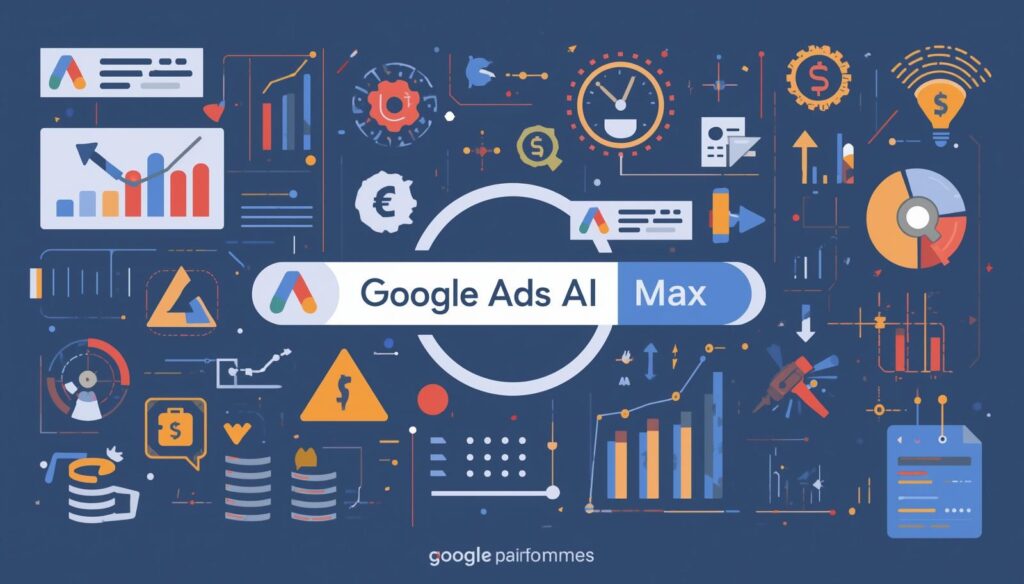
Digital marketing waits for nobody. If your Google Ads strategy still looks identical to last year’s playbook, you’re likely leaving money on the table without realizing it. At Aspire Digital Solutions, we don’t chase every trend, but we do pay close attention when Google rewrites the mechanics of paid search. The latest shift is called AI Max—a smart automation layer built directly into Search campaigns. The uncomfortable reality? AI Max can unlock impressive performance gains, but set up carelessly, it can steer your budget into dark corners you didn’t even know existed. Let’s break down what this feature actually does, why it matters now, and the hidden dangers nobody talks about.
What AI Max Actually Is (It’s Not a New Campaign Type)
AI Max isn’t a standalone campaign. It’s a toggle that sits inside your existing Search campaigns and, when switched on, supercharges them with predictive automation that goes far beyond standard keyword targeting and bidding. Google opened the beta after Marketing Live in May 2025, with full availability expected around Q3 2025. Once enabled, your campaigns unlock five core upgrades:
- Smarter matching that reaches past your keyword list to capture queries the system believes will convert
- Real-time creative tweaks that adjust headlines, descriptions, and assets based on searcher behavior
- Final URL expansion that can route clicks to whatever landing page the algorithm deems most relevant
- Fully dynamic bidding that adjusts in real time, moment by moment, using your conversion data
- New visibility tools, including AI match type reporting, asset-level insights, and URL exclusion controls
In plain terms, AI Max takes over the grunt work—targeting, creative assembly, bidding, delivery—so you can shift your focus toward higher-level strategy, messaging, and offers. But only if you keep a very close eye on what the machine is actually doing.
Why Advertisers Are Paying Attention
Manual campaign management certainly works, but it doesn’t scale gracefully. AI Max is designed to tackle three things that eat up a media buyer’s calendar and budgets:
- It reclaims your time by automating bid adjustments, ad testing, and day-to-day maintenance
- It sharpens targeting by tapping into your conversion history, audience signals, and behavioral patterns
- It pushes ROI further using smart bidding strategies—Maximize Conversions, Target ROAS—that react to signals no human could process in real time
- It adapts to market shifts faster than any team of analysts, adjusting to changes in search behavior almost instantly
AI Max vs. Performance Max: Two Different Animals
People confuse these constantly, but the boundaries are clear once you look at where they operate. Performance Max (PMax) runs across every Google channel—Search, Display, YouTube, Gmail, Discover—with a single, conversion-hungry feed. It’s broad by design. AI Max stays strictly within Search campaigns. Its job is to refine keyword reach, polish creative selection, and align landing pages with search intent in a way that PMax’s multi-channel engine simply can’t match. If Search is your revenue backbone, AI Max gives you deeper relevance and more nuanced controls than PMax ever could—provided you don’t let it run wild.
The Hidden Threats That Eat Your Budget Quietly
Automation without boundaries is a gamble, and AI Max is no exception. The very features built to lift performance can shift your spend into uncomfortable places if you aren’t watching.
Budget Drift You Won’t Notice Right Away
Money can slowly migrate away from proven, high-ROI keywords and into experimental queries or landing pages you never intended to test. Without rock-solid conversion tracking, this drift looks like budget simply evaporating.
Performance Instability During the Learning Phase
Plenty of accounts see impressive lifts. Others hit a rough patch where costs spike and conversions plummet while the system learns. If you treat AI Max as a “set once and walk away” feature, those swings can burn through a month’s budget in weeks.
Loss of Direct Oversight (And False Comfort)
Because the system makes so many decisions behind the curtain, advertisers who skip URL exclusions, feed weak creative, or ignore audience signals risk showing ads to less qualified prospects. It won’t feel random—it will feel like a slow leak until you dig into the data. The truth: AI Max is not plug-and-play. Left unchecked, it funds Google’s learning experiments. But when you feed it clean conversion data, firm exclusions, and strong creative, it’s not unusual to see 14% to 27% more conversions at costs comparable to your standard Search campaigns.
How to Make AI Max Work Without the Waste
To capture the upside without becoming a funding source for machine learning tests, your account needs to be genuinely AI-ready. Here’s what that looks like in practice.
Nail Your Data Foundation First
- Set up precise conversion tracking with values, not just counts
- Make sure GA4 is properly linked and passing data cleanly
- Import offline conversions if your sales cycle involves calls, meetings, or in-person transactions
- Assign crystal-clear goals at the campaign level—don’t make the machine guess
Feed the Machine Quality Creative
- Supply a robust set of headlines, descriptions, and clear CTAs
- Upload high-resolution images, videos, and visual assets that make sense for search landing pages
- Use every relevant extension—sitelinks, callouts, structured snippets—so the system has enough material to assemble varied ads
Give It Audience Signals That Matter
- Upload customer match lists, demographic profiles, and remarketing segments
- The more you tell it about who matters, the less budget it wastes on who doesn’t
- Think of audience signals as guardrails, not just suggestions
Practice Patient, Daily Vigilance
- Expect a learning period of roughly one to two weeks
- Monitor performance daily during that window—not weekly
- Be ready to adjust exclusions, budgets, targets, and creative based on what you observe, not what you hope
The Control Levers You Actually Have
Here’s a detail most advertisers miss: AI Max isn’t an all-or-nothing switch. Google offers three primary toggles that change the shape of the automation.
- Headline Generation – Let AI write new headlines, or keep it locked to the ones you provide
- Final URL Expansion – Allow AI to pick the landing page, or force it to respect your chosen URL
- Keyword Matching – Let AI reach searchers beyond your keywords, or keep targeting tight to your list
On paper, that spells control. But here’s what actually happens in many accounts: with all three toggles turned off, campaigns often struggle to deliver any meaningful impression volume. Google nudges you hard toward embracing some level of AI Max—so the real skill lies in choosing which levers to loosen and which to keep under lock and key. Find your balance. Maybe you allow broader keyword matching but keep headlines and landing pages strictly manual. Or the reverse. The only way to know is to test different configurations and let the data speak.
Is AI Max Right for Your Business Right Now?
AI Max tends to deliver strongest when a few conditions are already in place:
- You have clear conversion goals like sales, lead submissions, or bookings
- You want to cut down time spent on routine campaign management
- Your account already holds a solid history of conversion data
- You’re comfortable with a hybrid model—automation plus consistent human oversight
If your account is brand new and starved for conversion history, it’s usually smarter to build that foundation first, then flip the AI Max switch once the machine has something to work with.
[ad_2]