8 Automation Trends Every CMO Must Track in 2026
Not long ago, I sat across from a CMO at a midsized SaaS company. She looked exhausted. “We’ve got five different automation tools,” she said, “and somehow I feel less in control than when we had none.”
She’s not alone.
The marketing automation market is expected to hit $8.44 billion in 2026, up from $7.47 billion just last year. But spending more doesn’t always mean moving faster. In fact, many marketing leaders are realizing that isolated automation tools—bolted onto old processes—aren’t moving the needle. The real shift in 2026 isn’t about more automation. It’s about smarter systems.
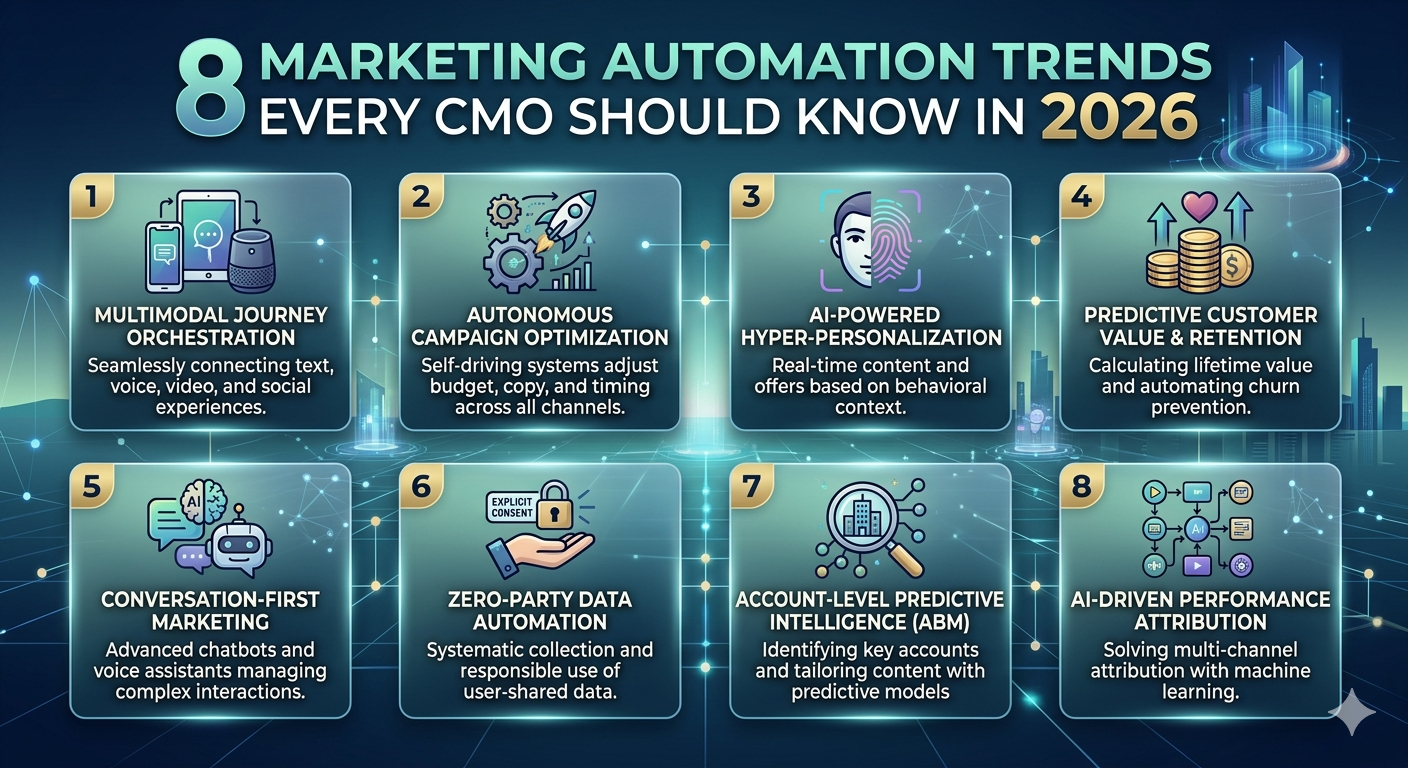
So what actually matters for CMOs right now? We’ve dug into the latest data from Gartner, McKinsey, Forrester, and HubSpot to pull out the eight trends that separate the leaders from the pack. No hype. No buzzwords. Just the trends you need to act on.
Let’s get started.
Trend 1 – Agentic AI Is Taking Over Routine Marketing Work
Here’s a number that should catch your attention. Gartner predicts the AI agent market will soar from $83.6 billion in 2024 to $512 billion by 2029. That’s a five‑year growth rate of nearly 44% each year.
But what does “agentic AI” actually mean for your team?
In simple terms, these are autonomous systems that don’t just suggest next steps. They execute them. For marketing, that could mean an AI agent that monitors engagement metrics, reallocates budget to better‑performing channels, and spins up a new email variant—all while you sleep.
McKinsey estimates that agentic AI could soon power two‑thirds of current marketing activities, from content generation to audience‑based media planning. And Gartner found that 40% of enterprise applications will include task‑specific AI agents by the end of 2026. [EXTERNAL LINK: Gartner]
So what does this look like in practice? One European marketing leader told McKinsey that the hardest part isn’t buying the tools—it’s “rewiring” internal processes so AI becomes central to daily work, not just a side project. The winners are the ones making agentic AI part of their core operating model, not an experiment.
Trend 2 – Hyper‑Personalization Is Now a Market Share Battleground
Basic personalization used to be a nice differentiator. Not anymore.
McKinsey’s 2026 Global B2B Pulse Survey shows a clear split between growth leaders and everyone else. Among companies that grew market share by more than 10% last year, half said their email campaigns are very personalized, and 15% are doing true one‑to‑one personalization. In contrast, among companies that lost market share, only 18% described their email campaigns as very personalized.
That’s a gap you can’t ignore.
Hyper‑personalization means tailoring every interaction—content, timing, channel, offer—to what you know about that specific buyer. And automation is what makes it possible without burning out your team. AI‑powered platforms can now ingest behavioral data, predict intent, and adjust messaging in real time.
The catch? You need clean, unified customer data first. Garbage in, garbage out. But when it works, the payoff is real: higher engagement, stronger loyalty, and a measurable edge over competitors still stuck on “Hey [First Name]” emails.
Trend 3 – AEO (Answer Engine Optimization) Replaces Old‑School SEO
Organic search traffic is down 27% year over year, according to HubSpot internal data. But that’s not because websites got worse. It’s because buyers have moved.
They’re asking ChatGPT, Claude, and Gemini the questions they used to type into Google. And those buyers? They’re 36% more likely to purchase.
That’s a massive shift.
CMOs now need to think about Answer Engine Optimization (AEO)—ensuring your brand shows up when AI models generate answers. HubSpot found that customers actively optimizing for AEO are generating 20% more traffic from AI visits, 170% more MQLs, and 82% more deals. [EXTERNAL LINK: HubSpot]
So what does AEO require? For starters, structured content that AI can parse, clear answers to common buyer questions, and consistent messaging across your website, reviews, and third‑party mentions. Traditional SEO isn’t dead, but it’s no longer enough.
Trend 4 – Leaner Teams, Smarter Workflows
Marketing budgets as a share of revenue have declined, according to the Spring 2026 CMO Survey. But expectations? They’ve only gone up.
Sixty‑three percent of CMOs now feel pressure from their CFOs to deliver measurable results—often with fewer people on the team.
The solution isn’t to work harder. It’s to automate the routine so your team can focus on strategy.
We’re seeing smart CMOs redirect their talent away from manual tasks (like pulling reports or scheduling social posts) and toward higher‑value work: creative direction, customer insights, and testing new channels. Automation handles the repetition. Humans handle the judgment.
But here’s the catch. The same CMO Survey found that many organizations lack the in‑house skills to manage sophisticated automation tools. So the trend isn’t just toward automation—it’s toward upskilling your existing team or bringing in partners who can bridge the gap.
Trend 5 – Real‑Time Data Activation, Not Just Reporting
For years, “data‑driven marketing” meant looking at last month’s dashboard and making a few adjustments. That era is over.
In 2026, leading marketing teams are activating data in real time—adjusting bids, offers, and creative while campaigns are still running.
Gartner’s 2026 marketing predictions emphasize that AI agents will collapse traditional campaign cycles, moving from batch‑and‑blast to fluid, autonomous customer journeys. That means your martech stack needs to support real‑time decisions, not just static workflows.
For CMOs, the question shifts from “What happened?” to “What should we do right now?” And the automation platforms that answer that question well are the ones worth keeping.
Trend 6 – Composable Marketing Organizations
Here’s a prediction from Gartner that might reshape your org chart: by 2028, half of CMOs will shift to fully composable marketing structures, where AI‑dependent teams work in self‑reliant resource ecosystems.
What does that mean in plain English? Instead of rigid hierarchies and siloed functions, teams become modular and flexible. A product marketer might collaborate directly with an AI agent on campaign execution. An analyst might shift between brand, demand, and customer marketing week to week.
Gartner also found that 62% of CMOs say AI‑driven automation has already forced them to rethink roles and flatten structures. The days of “I just run email” are fading. The new skills? Digital dexterity, strategic thinking, and cross‑functional problem‑solving.
If your org chart hasn’t changed in two years, it’s probably overdue.
Trend 7 – Governance Is the New Competitive Advantage
Here’s the uncomfortable truth. All this automation and AI comes with risk.
McKinsey calls it the “gen AI paradox”: the technology is everywhere—except on the bottom line. Why? Because most organizations haven’t put the right governance in place.
When agents make decisions automatically, who’s accountable for a brand mistake? When AI generates content, who checks it for compliance? When personalization goes wrong, who fixes the customer relationship?
The CMOs winning in 2026 aren’t just buying automation tools. They’re building guardrails. That means clear policies on data use, human review checkpoints for high‑stakes outputs, and regular audits of how AI represents the brand.
Without governance, automation becomes a liability, not a lever.
Trend 8 – Automation ROI Is Under the Microscope
Finally, the bottom line.
Sixty‑eight percent of marketers expect their automation budget to increase next year, according to an Ascend2 survey. But spending isn’t the same as performing.
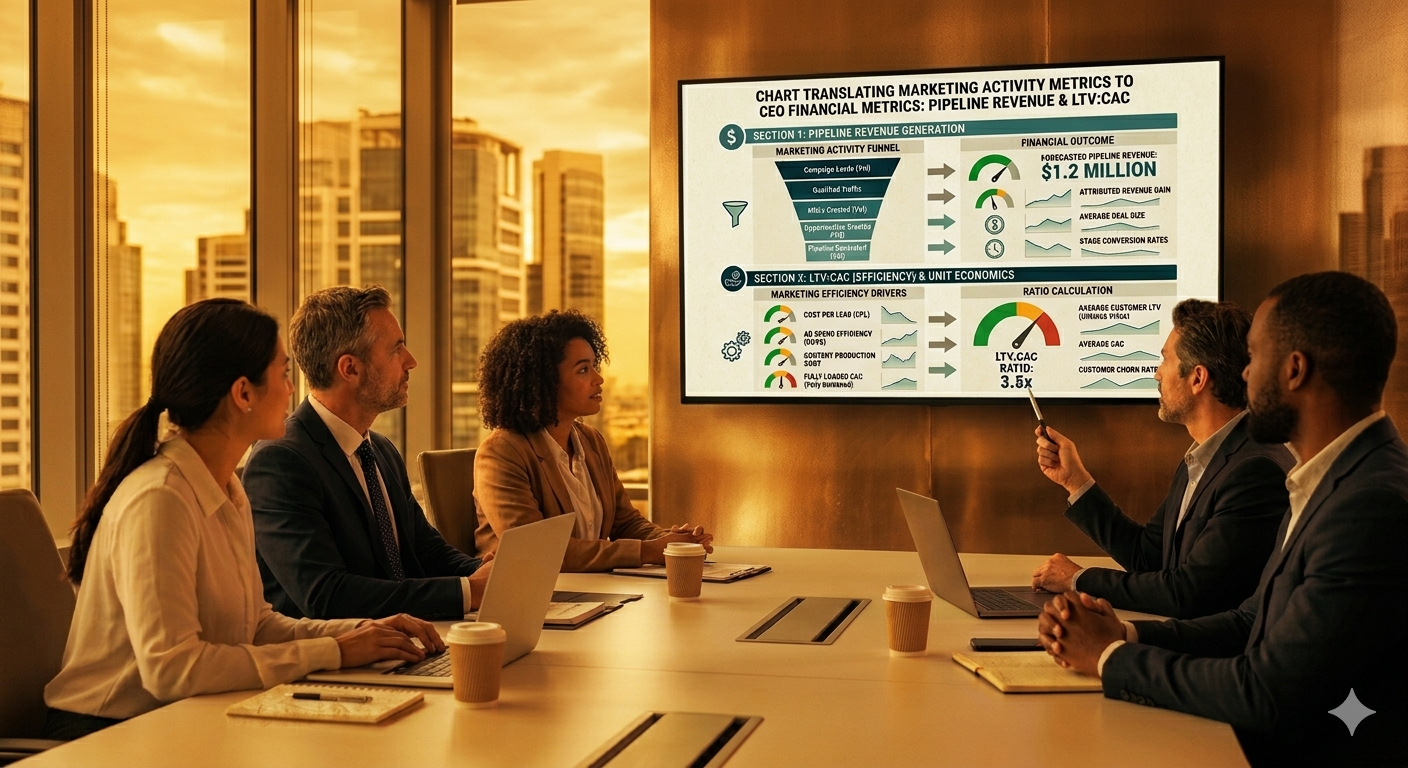
CFOs are demanding clearer links between automation spend and revenue outcomes. That means CMOs need to move beyond vanity metrics (emails sent, workflows created) and tie automation directly to pipeline acceleration, deal size, and customer lifetime value.
The good news? When it’s done right, automation delivers. According to McKinsey, organizations using AI in marketing can improve productivity by up to 20%. Salesforce found that over 75% of high‑performing marketing teams are already leveraging AI to enhance engagement and campaign performance.
So the question isn’t whether automation works. It’s whether your automation works—and whether you can prove it.
How to Start Proving ROI Today
Start with one question: What would change if you automated a single, manual process that currently eats five hours a week?
Pick something small. Track time saved. Measure quality of output. Then scale. That’s how you build a business case that even the toughest CFO can’t argue with.
Conclusion: Your Next Move Starts Now
Let’s bring this back to where we started.
Marketing automation in 2026 isn’t about buying more tools. It’s about building smarter systems—systems that personalize at scale, act autonomously, and prove their worth in real terms. The trends we’ve covered here aren’t distant predictions. They’re already separating the leaders from the laggards.
So here’s your one immediate next step. Block two hours this week. Pull your team together. Review each trend and ask: Where are we now? Where should we be in six months?
Then pick one area to improve. Maybe it’s cleaning up your customer data to enable better personalization. Maybe it’s auditing your content for AEO. Maybe it’s setting up a simple governance checklist for AI‑generated assets.
Don’t try to fix everything at once. Just start.
Because the CMOs who act on these trends today will be the ones writing the playbook tomorrow.