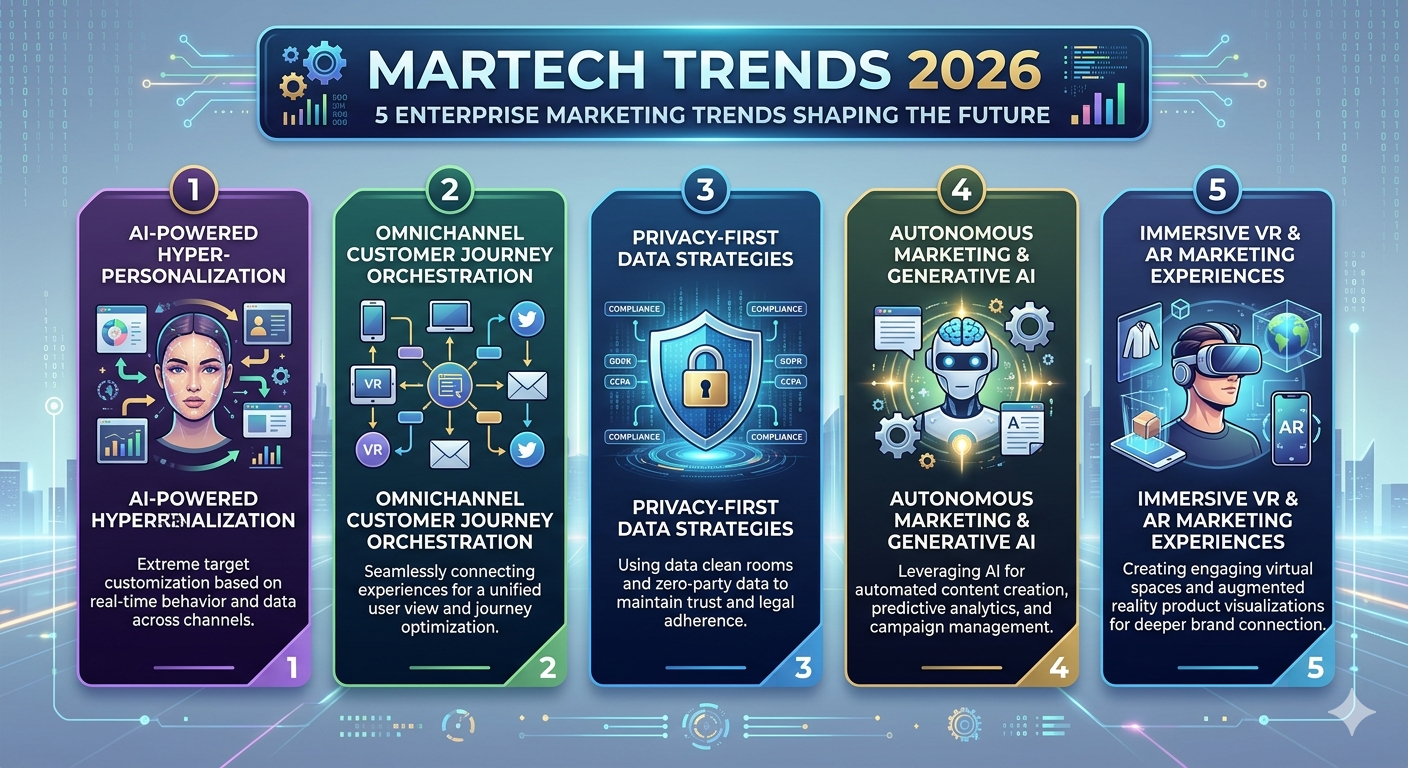
Top MarTech Trends That Will Shape Enterprise Marketing in 2026
Enterprise marketing is entering a period of significant transformation. After years of rapid MarTech expansion, many organizations are discovering that adding more platforms does not automatically create better customer experiences.
The challenge for marketing leaders in 2026 will not be finding another tool. It will be creating a connected technology ecosystem where data, artificial intelligence, automation, and human creativity work together.
From AI-powered personalization to composable technology stacks and privacy-first data strategies, the next generation of MarTech will be defined by smarter decisions, stronger governance, and simpler operations.
For enterprise marketing teams, 2026 will be less about collecting more technology and more about making existing investments deliver measurable business value.
The Shift From MarTech Expansion to MarTech Optimization
Over the last decade, enterprises have built increasingly complex marketing technology stacks. Customer relationship management platforms, automation systems, analytics tools, content platforms, and customer data platforms have become essential parts of modern marketing operations.
However, complexity has created new challenges. Data often remains fragmented, teams struggle with disconnected workflows, and marketers spend significant time managing systems instead of improving customer experiences.
The leading organizations in 2026 will focus on three priorities:
- Creating unified customer data foundations
- Using AI responsibly across marketing operations
- Building flexible technology ecosystems
1. AI-Powered Personalization Becomes a Marketing Standard
Personalization has moved far beyond adding a customer’s first name to an email. In 2026, enterprise marketers will increasingly use artificial intelligence to understand customer behavior, predict intent, and deliver more relevant experiences across channels.
The goal is not simply to produce more personalized messages. The goal is creating experiences that feel timely, useful, and connected.
From Campaign Personalization to Customer Intelligence
Traditional personalization often depended on predefined customer segments. AI-driven marketing systems are changing this approach by analyzing larger volumes of behavioral signals in real time.
Modern marketing teams are using AI to support:
- Customer journey optimization
- Content recommendations
- Predictive audience targeting
- Automated campaign adjustments
- Sales and marketing alignment
Platforms such as Salesforce Data Cloud, Adobe Experience Platform, and customer data platforms (CDPs) are helping enterprises connect information from multiple touchpoints and create a more complete understanding of customers.
The Challenge: Personalization Without Losing Trust
While AI enables deeper personalization, enterprises must balance relevance with privacy. Customers expect brands to understand their needs, but they also expect transparency about how their data is collected and used.
The successful brands in 2026 will not be those that personalize everything. They will be the ones that personalize responsibly.
A strong AI personalization strategy requires:
- Clean and reliable customer data
- Clear consent management practices
- Human oversight of AI decisions
- Consistent brand messaging across channels
Marktngwave Insight: The biggest personalization challenge in 2026 will not be AI capability. It will be data quality. Enterprises that fix fragmented customer information will gain the greatest advantage from AI-driven marketing.
2. Composable MarTech Stacks Become the Enterprise Standard
For years, enterprise marketing leaders invested heavily in all-in-one marketing suites promising a complete solution for every business need. These platforms helped organizations centralize operations, but many enterprises discovered that flexibility and innovation could become difficult when every capability depended on a single vendor ecosystem.
In 2026, more marketing teams will move toward composable MarTech architectures — technology environments built from connected, specialized solutions rather than one large platform controlling everything.
What Is a Composable MarTech Stack?
A composable MarTech stack allows enterprises to select the best technology components for specific business requirements and connect them through APIs, automation, and shared data infrastructure.
Instead of replacing an entire marketing ecosystem, companies can improve individual capabilities while maintaining flexibility.
A modern composable architecture may include:
- A customer data platform or centralized data warehouse
- A content management system
- Marketing automation tools
- AI-powered analytics and decision engines
- Customer engagement platforms
- Specialized industry solutions
Why Enterprises Are Moving Toward Modular Technology
Marketing teams need technology that can adapt quickly. Customer expectations change rapidly, new AI capabilities appear frequently, and businesses cannot afford years-long technology replacement cycles.
Composable stacks provide several advantages:
- Greater flexibility when adopting new technology
- Reduced dependence on a single vendor
- Faster experimentation
- Better alignment between marketing and business goals
- More control over customer data
Leading enterprise platforms such as Salesforce, Adobe Experience Cloud, Snowflake, and modern API-driven marketing solutions are increasingly becoming part of broader connected ecosystems rather than isolated platforms.
The New Role of Marketing Operations
Composable MarTech does not mean simply buying more tools. Without strong governance, a flexible stack can quickly become another source of complexity.
Marketing operations teams will play a critical role in 2026 by creating:
- Technology standards
- Data management processes
- Integration strategies
- Measurement frameworks
Marktngwave Insight: The future of enterprise MarTech is not about owning the largest technology stack. It is about building the most adaptable one.
3. First-Party Data Becomes a Strategic Marketing Advantage
As privacy regulations evolve and third-party tracking becomes more limited, enterprise marketers are placing greater importance on first-party data — information collected directly through customer interactions.
The organizations that succeed in 2026 will not simply collect more data. They will create better systems for understanding, managing, and activating the data they already have.
From Data Collection to Data Strategy
Many companies have accumulated large amounts of customer information through websites, applications, sales interactions, and digital campaigns. However, data volume alone does not create marketing intelligence.
The challenge is turning disconnected information into useful customer insights.
A strong first-party data strategy includes:
- Accurate customer profiles
- Clear consent management
- Preference-based communication
- Data quality improvement
- Cross-channel activation
Zero-Party Data Gains More Attention
Beyond traditional first-party data, enterprises are increasingly exploring zero-party data — information customers intentionally share about their preferences, interests, and expectations.
Examples include:
- Product preference surveys
- Personalization quizzes
- Customer preference centers
- Interactive experiences
This approach creates a more transparent relationship between brands and customers. Instead of guessing customer intent, companies can ask customers directly what matters to them.
Customer Trust Becomes Part of Data Strategy
The future of data-driven marketing depends on trust. Customers are more likely to share information when brands clearly explain the value they receive in return.
Successful enterprises will focus on creating meaningful value exchanges:
- Better product recommendations
- More relevant communication
- Improved customer experiences
- Greater control over preferences
Marktngwave Insight: First-party data is no longer just a marketing asset. It is becoming a foundation for customer relationships, AI performance, and long-term brand trust.
4. Generative AI Moves From Experimentation to Enterprise Operations
Generative AI has moved quickly from an emerging technology discussion to a practical business priority. Many marketing teams have already experimented with AI tools for content creation, campaign ideas, customer insights, and workflow automation.
However, 2026 will represent a different stage of AI adoption. Enterprise marketing teams will move away from isolated experiments and focus on creating repeatable, controlled AI-powered processes.
From AI Tools to AI Workflows
The biggest opportunity for enterprises is not simply generating more content. It is creating smarter workflows where AI supports marketers throughout the customer journey.
Examples of enterprise AI applications include:
- Creating first drafts of marketing content
- Adapting messaging for different customer segments
- Analyzing campaign performance
- Supporting customer research
- Automating repetitive marketing operations
- Improving internal knowledge management
The most successful marketing organizations will treat AI as a productivity partner rather than a replacement for strategic thinking and creativity.
The Importance of AI Governance
As AI becomes embedded into marketing operations, enterprises will need clear rules around how these systems are used.
Responsible AI adoption requires:
- Brand voice guidelines
- Human review processes
- Data protection standards
- Content accuracy checks
- Clear employee AI policies
Without governance, organizations risk inconsistent messaging, inaccurate information, and customer trust issues.
The Human Advantage Remains Critical
AI can accelerate execution, but human expertise remains essential for strategy, creativity, empathy, and decision-making.
The strongest marketing teams in 2026 will combine:
- AI efficiency
- Human creativity
- Industry expertise
- Customer understanding
Marktngwave Insight: The competitive advantage will not come from companies that simply use AI. It will come from companies that know where AI creates value and where human judgment matters most.
5. Privacy and Trust Become Growth Drivers
Privacy has traditionally been viewed as a compliance responsibility. In 2026, forward- thinking enterprises will increasingly recognize trust as a competitive advantage.
Customers are becoming more aware of how companies collect and use information. Brands that communicate clearly about data practices can build stronger relationships and reduce customer hesitation.
Privacy-First Marketing Becomes Standard Practice
Modern MarTech strategies will increasingly include privacy considerations from the beginning rather than treating them as a final compliance step.
Key areas of focus include:
- Consent management
- Data governance
- Identity protection
- Secure customer data platforms
- Responsible AI usage
Trust Influences Buying Decisions
In enterprise markets especially, trust plays an important role in purchasing decisions. Companies evaluating technology partners increasingly consider security, transparency, and responsible data practices alongside features and pricing.
Marketing leaders who integrate trust into their customer experience strategy can create stronger relationships with both customers and business stakeholders.
Marktngwave Insight: Privacy is no longer only a legal requirement. It is becoming part of the customer experience and brand reputation strategy.
The Bigger Picture: MarTech in 2026 Will Be About Simplification
The major MarTech trends shaping 2026 share a common theme: moving from complexity toward clarity.
Enterprise marketing leaders will focus less on acquiring more platforms and more on building connected systems that create measurable business outcomes.
The organizations positioned for success will prioritize:
- Unified customer data
- Responsible artificial intelligence
- Flexible technology architecture
- Privacy-first customer relationships
- Marketing operations maturity
The future of MarTech will not belong to companies with the largest number of tools. It will belong to companies that can connect technology, data, and people effectively.
Frequently Asked Questions About MarTech Trends in 2026
What is the biggest MarTech trend for 2026?
Artificial intelligence will remain one of the biggest drivers of MarTech transformation in 2026, especially in areas such as personalization, automation, analytics, and content operations.
Will AI replace marketing teams?
AI is expected to change how marketing teams work, but human expertise will remain important for strategy, creativity, customer understanding, and brand decision-making.
Why are enterprises moving toward composable MarTech stacks?
Composable architectures provide greater flexibility by allowing companies to combine specialized tools instead of depending entirely on one platform.
Why is first-party data important for future marketing?
First-party data helps companies create better customer experiences while reducing dependence on third-party tracking methods and improving privacy control.
How should companies prepare for MarTech changes in 2026?
Companies should evaluate their current technology ecosystem, improve data quality, establish AI governance practices, and focus on technology investments that support business outcomes.
Final Takeaway
The next era of enterprise marketing will not be defined by how many MarTech platforms a company owns. It will be defined by how effectively those platforms work together.
AI, data, automation, and privacy will continue transforming marketing operations, but the foundation remains simple: understand customers, create value, and build trust.
For marketing leaders, the 2026 opportunity is clear — simplify the stack, strengthen the strategy, and use technology to create experiences that genuinely help customers.