LinkedIn Predictive Audiences Push B2B AdTech Into AI-First Era
B2B advertising is entering a new phase where audience intelligence is becoming as important as creative quality, media budgets, and sales alignment. LinkedIn’s Predictive Audiences represents a major shift in how B2B marketers identify potential buyers by moving beyond traditional targeting methods based only on job titles, industries, company size, and manual audience lists.
For years, B2B marketers have struggled with a fundamental challenge: reaching the right decision-makers without wasting budget on low-intent audiences. Traditional account-based advertising improved precision but often required significant manual effort, limited scale, and extensive data preparation.
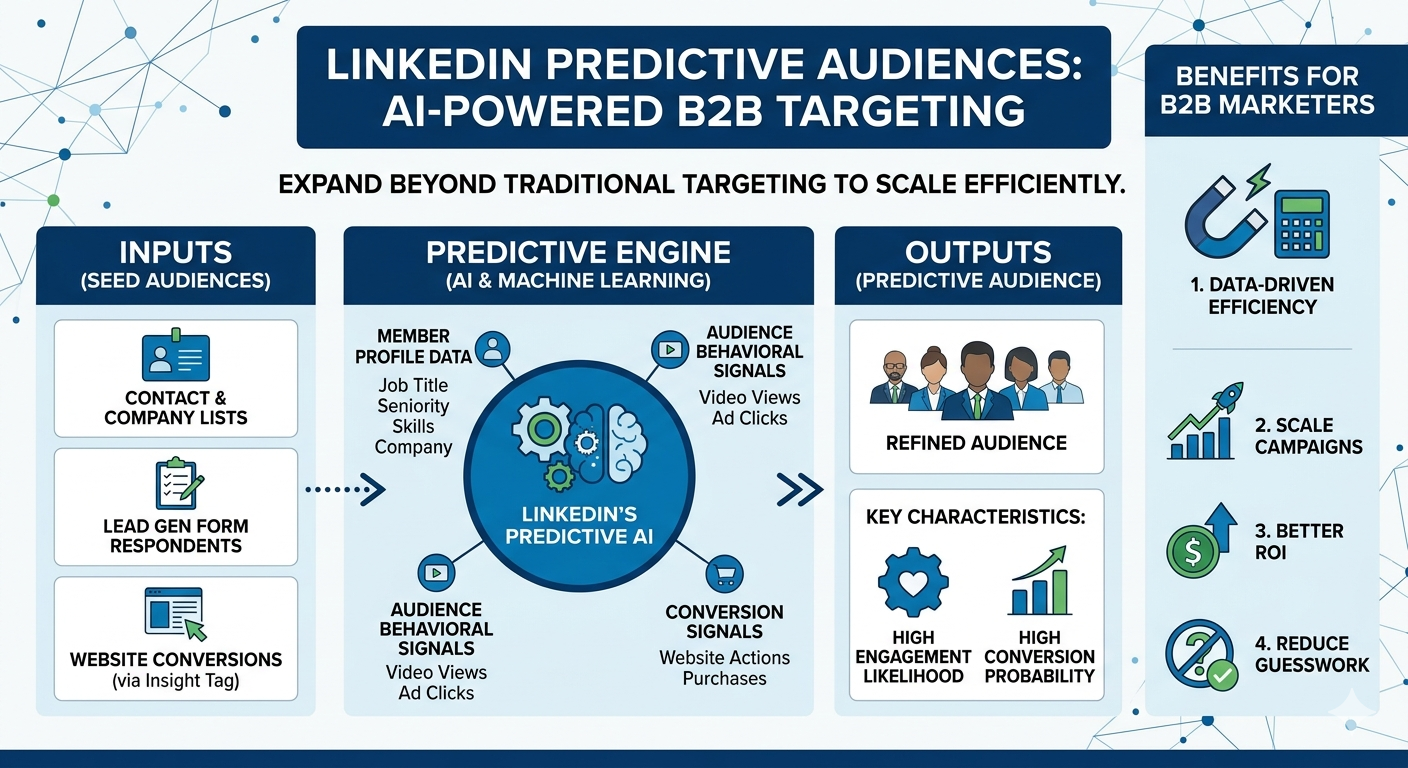
LinkedIn Predictive Audiences changes this equation by using predictive modeling to analyze signals from first-party data, platform engagement, and conversion patterns to identify audiences more likely to take action. LinkedIn describes the capability as a way to expand beyond traditional lookalike approaches by focusing on users with stronger conversion potential.
For CMOs, revenue leaders, and demand generation teams, the implication is significant: B2B advertising is moving from audience selection toward audience prediction.
The winners will not simply be companies spending more on advertising. They will be organizations that combine better data quality, stronger messaging, accurate attribution, and disciplined experimentation.
The End of Manual B2B Audience Targeting?
B2B marketers have historically relied on predictable targeting formulas:
- Industry
- Company size
- Job title
- Seniority level
- Location
- Professional interests
These filters remain valuable, but modern buying behavior has become far more complex.
A software buyer may interact with a thought leadership article, watch product videos, engage with competitor content, attend webinars, visit pricing pages, and discuss solutions internally long before filling out a form.
The traditional advertising model often sees only the final conversion event.
The modern B2B adtech model attempts to understand the journey before the conversion happens.
This is where LinkedIn Predictive Audiences enters the conversation.
Rather than asking:
“Who looks like our existing customers?”
the question becomes:
“Who is most likely to become our next valuable customer?”
That difference represents a major strategic change.
According to LinkedIn, Predictive Audiences combines first-party company data with platform engagement signals and predictive models to identify higher-intent audiences.
For enterprise marketers managing expensive sales cycles, this shift could redefine how paid media contributes to pipeline creation.
Why B2B Advertising Needs Predictive Intelligence
The Problem With Traditional B2B Targeting
B2B marketers have always faced a balancing act:
- Narrow targeting improves relevance but limits reach.
- Broad targeting increases scale but introduces wasted spend.
For example, a cybersecurity company selling enterprise solutions may define its audience as:
- CISOs
- Security Directors
- IT executives
- Companies with more than 1,000 employees
However, not every CISO is actively evaluating cybersecurity software.
Some organizations may have immediate buying intent. Others may have no budget, no project, or no urgency.
The challenge is identifying the difference.
Traditional targeting answers:
“Who fits our customer profile?”
Predictive targeting attempts to answer:
“Who fits our customer profile and demonstrates signals suggesting they may buy?”
What Are LinkedIn Predictive Audiences?
Definition
LinkedIn Predictive Audiences is an AI-powered audience expansion capability within LinkedIn advertising that helps marketers discover and reach additional professionals who share characteristics and behaviors with high-value customers.
Unlike traditional B2B lookalike audiences, predictive audiences analyze multiple signals to estimate which users are more likely to complete a desired action.
These signals can include:
- Existing customer lists
- Conversion data
- Website activity
- Ad engagement
- Professional characteristics
- LinkedIn behavioral patterns
LinkedIn positions Predictive Audiences as an evolution beyond traditional audience matching by focusing on conversion likelihood rather than simple similarity.
Why LinkedIn Predictive Audiences Matters for B2B Marketers
1. Moving From Demographic Targeting to Intent-Based Advertising
The biggest change is the move from static audience definitions toward dynamic audience discovery.
Traditional B2B advertising:
Predictive advertising:
“Find marketing executives at SaaS companies who demonstrate behaviors similar to customers who eventually converted.”
This creates a more intelligent approach to paid acquisition.
For demand generation teams, the impact can include:
- Better audience quality
- Reduced wasted impressions
- Improved conversion rates
- More efficient testing
However, predictive targeting does not replace strategy.
Poor positioning, weak offers, or unclear messaging can still produce poor results.
Better targeting only improves the efficiency of the system behind a good campaign.
The Rise of AI-First B2B AdTech
The broader advertising industry is moving toward automation, predictive analytics, and intelligent optimization.
B2B marketers are increasingly adopting systems that can:
- Identify high-value accounts
- Predict buying behavior
- Optimize campaigns automatically
- Connect advertising signals with revenue outcomes
LinkedIn’s own B2B marketing research highlights how buying groups are becoming larger and more complex, requiring marketers to adapt their strategies around changing buyer behavior.
The shift is not simply technological.
It represents a change in operating philosophy.
The old model:
Campaign → Leads → Sales Follow-up
The emerging model:
Data Signals → Predictive Audience → Personalized Engagement → Revenue Impact
Key Trends Driving the AI-First B2B Advertising Era
1: The Decline of Generic Lead Generation
Many B2B companies still measure advertising success using:
- Cost per lead
- Form submissions
- Click volume
These metrics are becoming less meaningful.
A cheap lead that never becomes an opportunity creates negative ROI.
Revenue leaders increasingly want advertising teams connected to:
- Pipeline contribution
- Opportunity creation
- Customer acquisition cost
- Lifetime value
Predictive audiences support this shift by helping marketers focus on quality rather than quantity.
2: B2B Lookalike Audiences Are Becoming More Intelligent
Traditional B2B lookalike audiences were built around similarity.
A company uploaded customer data, and advertising platforms found similar users.
The limitation:
Similarity does not always equal buying intent.
A person may share the same job title, industry, and company size but have completely different priorities.
Predictive audiences attempt to introduce another layer:
Likelihood to convert.
This changes audience expansion from a matching exercise into a probability-based decision.
3: Account-Based Advertising Meets Predictive Analytics
Account-based marketing (ABM) has become one of the strongest strategies in enterprise marketing.
However, ABM has historically required:
- Extensive research
- Manual account selection
- Sales-marketing coordination
- Data enrichment
Predictive targeting can make ABM more scalable.
Instead of selecting only 500 target accounts manually, companies can identify thousands of professionals who demonstrate characteristics associated with successful customers.
The future of ABM will likely combine:
- Human account strategy
- Predictive audience discovery
- Intent signals
- Revenue attribution
Expert Analysis: The Opportunity and the Risk
The Opportunity
For B2B marketers, LinkedIn Predictive Audiences creates three major opportunities:
1. Expanding Reach Without Losing Relevance
Many companies struggle when scaling campaigns.
Increasing audience size often reduces quality.
Predictive targeting provides another path:
Increase reach while maintaining audience intelligence.
2. Improving Campaign Efficiency
Paid media costs continue rising across competitive B2B categories.
Marketing teams need better ways to justify spend.
Predictive audience technology can help by improving the probability that advertising reaches valuable prospects.
3. Creating Stronger Sales Alignment
When marketing can identify audiences showing stronger buying signals, sales teams receive better-quality opportunities.
This supports a more connected revenue engine.
The Risk: The Black Box Marketing Problem
The biggest concern with predictive advertising is transparency.
Many marketers worry about entering a “black box marketing” environment where algorithms make decisions that teams cannot fully explain.
The question becomes:
Why was this audience selected?
Why did this campaign outperform another?
Which signals influenced the outcome?
For enterprise marketers, transparency matters.
The future of B2B adtech will require a balance between:
- Automated decision-making
- Human oversight
- Clear measurement
- Account-based intelligence
Technology should improve strategic decisions, not remove accountability.
Comparison: Traditional Targeting vs Predictive Audiences
| Area | Traditional B2B Targeting | Predictive Audiences |
|---|---|---|
| Audience creation | Manual filters | Predictive modeling |
| Primary inputs | Demographics and firmographics | Data signals and behavior patterns |
| Scaling ability | Limited | Higher expansion potential |
| Optimization | Campaign manager decisions | Data-driven optimization |
| Focus | Audience similarity | Conversion likelihood |
| Risk | Narrow reach | Reduced transparency |
What Marketing Leaders Should Understand
LinkedIn Predictive Audiences does not eliminate the need for:
- Strong positioning
- Customer research
- Creative testing
- Sales feedback
- Attribution discipline
It changes where marketers spend their strategic energy.
The next generation of B2B advertising professionals will spend less time manually building audiences and more time improving:
- Data quality
- Messaging
- Buyer journeys
- Revenue measurement
The competitive advantage will come from combining technology with marketing judgment.
Building a Predictive B2B Advertising Strategy: A Practical Framework
The introduction of predictive audiences does not mean marketers should simply activate a new targeting option and expect better results.
Successful adoption requires a disciplined approach that connects data, audience strategy, creative execution, sales alignment, and measurement.
For B2B organizations, the objective should not be “more leads.”
The objective should be:
More predictable pipeline creation from the right buyers.
Below is a practical framework marketing teams can use when implementing LinkedIn Predictive Audiences and other AI-driven B2B campaigns.
A Five-Step Framework for Using LinkedIn Predictive Audiences Effectively
1: Start With High-Quality Customer Data
Predictive systems are only as effective as the information they receive.
Many companies begin audience expansion with incomplete customer data:
- Old customer lists
- Duplicate contacts
- Poor CRM hygiene
- Inaccurate account information
Before activating predictive audiences, marketing teams should review:
Customer Data Checklist
✓ Identify highest-value customers
✓ Separate enterprise customers from low-value accounts
✓ Remove outdated contacts
✓ Segment customers by industry and use case
✓ Connect CRM outcomes with advertising data
A list containing thousands of low-quality leads may produce weaker results than a smaller audience built around successful customers.
The goal is not maximum volume.
The goal is maximum learning quality.
2: Define the Revenue Outcome Before Campaign Launch
One of the biggest mistakes in B2B advertising is starting with a media objective instead of a business objective.
A campaign should answer:
“What business outcome are we trying to influence?”
Examples:
| Business Goal | Advertising Objective |
|---|---|
| Increase enterprise pipeline | Reach high-intent decision-makers |
| Enter a new market | Identify similar high-value prospects |
| Improve sales velocity | Engage buying committees earlier |
| Increase account penetration | Expand within target industries |
For revenue teams, LinkedIn ad attribution becomes increasingly important.
Clicks and impressions provide visibility, but they do not prove business impact.
The strongest measurement approach connects:
Advertising exposure → Engagement → Marketing qualified accounts → Sales opportunities → Revenue
3: Combine Predictive Audiences With Account-Based Marketing
Predictive audiences should not replace ABM.
They should strengthen it.
A modern B2B advertising approach combines:
Traditional ABM
- Named account lists
- Sales-selected companies
- Strategic account plans
With:
Predictive Expansion
- Similar high-value companies
- Emerging buying signals
- New potential decision-makers
For example:
A cloud security company may have 1,000 target accounts identified by sales.
Predictive audience expansion may discover additional professionals at companies displaying similar characteristics to existing customers.
This creates a wider opportunity pool without abandoning strategic focus.
4: Create Content for Different Buyer Stages
Better targeting does not solve irrelevant messaging.
B2B buying groups contain multiple stakeholders:
- Executives
- Technical evaluators
- Procurement teams
- Finance leaders
- End users
Each group has different concerns.
Example: Enterprise CRM Software Campaign
| Audience | Message Focus |
|---|---|
| CMO | Revenue growth and customer insights |
| Sales VP | Pipeline efficiency |
| Operations Leader | Process automation |
| CFO | Cost efficiency and ROI |
AI-driven B2B campaigns perform best when audience intelligence is matched with relevant content.
5: Continuously Test and Improve
Predictive targeting should be treated as an optimization process.
Leading teams continuously test:
- Audience segments
- Creative formats
- Offers
- Landing pages
- Conversion paths
A mature testing cycle includes:
- Launch campaign
- Analyze engagement quality
- Review sales feedback
- Identify high-performing segments
- Adjust messaging and budget allocation
The companies gaining the most value from predictive advertising will be those that treat campaigns as learning systems rather than one-time launches.
Common Mistakes Companies Make With Predictive B2B Advertising
1: Assuming Better Targeting Fixes Weak Positioning
Technology cannot compensate for unclear messaging.
If buyers do not understand:
- The problem being solved
- Why the solution matters
- Why they should act now
Even highly accurate targeting will struggle.
Marketing leaders should evaluate:
“Would our ideal customer immediately understand why this offer matters?”
2: Measuring Only Lead Volume
A predictive audience campaign may produce fewer leads but higher-quality opportunities.
Example:
Campaign A:
- 1,000 leads
- 20 sales opportunities
Campaign B:
- 300 leads
- 35 sales opportunities
The second campaign creates more revenue potential.
B2B marketing measurement must move beyond volume metrics.
Important metrics include:
- Pipeline generated
- Opportunity conversion rate
- Revenue influenced
- Customer acquisition cost
- Sales cycle length
3: Ignoring Sales Feedback
Marketing platforms provide valuable signals, but sales conversations provide another layer of intelligence.
Sales teams can identify:
- Wrong industries
- Poor-fit companies
- Incorrect personas
- Emerging buyer objections
The strongest B2B organizations create feedback loops between:
Marketing → Sales → Customer Success → Marketing
4: Treating Predictive Audiences as a Replacement for Strategy
Predictive technology should support marketers, not replace strategic thinking.
Companies still need:
- Market positioning
- Customer research
- Competitive analysis
- Strong creative
- Clear differentiation
The best-performing teams combine automation with human expertise.
Future Outlook: Where B2B AdTech Is Heading
The next stage of B2B advertising will be defined by deeper integration between marketing platforms, customer data, and revenue systems.
Several developments are likely to shape the market.
1. Advertising Will Become More Revenue-Centric
The traditional marketing funnel:
Awareness → Leads → Sales
is evolving.
Companies increasingly want:
Advertising → Engagement → Pipeline → Revenue
This will increase pressure on marketing teams to prove business impact.
CMOs will increasingly evaluate advertising platforms based on:
- Pipeline contribution
- Customer acquisition efficiency
- Revenue influence
2. First-Party Data Will Become More Valuable
Privacy changes and reduced third-party tracking are making first-party customer data a strategic asset.
Companies with:
- Clean CRM systems
- Strong customer databases
- Accurate lifecycle tracking
will have an advantage.
The future of B2B targeting depends less on collecting more data and more on using existing data intelligently.
3. Transparency Will Become a Competitive Requirement
As predictive systems become more sophisticated, marketers will demand greater visibility.
Future B2B advertising platforms will need to provide:
- Better reporting
- Clear audience insights
- Explainable recommendations
- Stronger attribution models
The industry must avoid creating an environment where marketers cannot understand why decisions are being made.
4. Human Strategy Will Remain Essential
Despite increasing automation, successful B2B marketing will continue to depend on human expertise.
Technology can identify patterns.
Marketers must decide:
- Which markets to pursue
- Which problems matter
- How brands should communicate
- How customers should experience the buying journey
The competitive advantage will come from combining intelligent systems with strategic marketing leadership.
Frequently Asked Questions (FAQ)
What are LinkedIn Predictive Audiences?
LinkedIn Predictive Audiences is a targeting capability designed to help B2B advertisers discover additional professionals who are likely to engage or convert based on signals from existing customer data, engagement behavior, and audience characteristics.
How are LinkedIn Predictive Audiences different from lookalike audiences?
Traditional B2B lookalike audiences focus mainly on finding users who resemble existing customers. Predictive audiences aim to identify users who are more likely to take a desired action by analyzing multiple behavioral and conversion signals.
Are LinkedIn Predictive Audiences useful for enterprise B2B marketing?
Yes. Enterprise marketers can use predictive audiences to expand reach beyond manually selected account lists while maintaining focus on professionals who resemble high-value customers.
Do predictive audiences replace account-based marketing?
No. Predictive audiences work best alongside ABM strategies. They help marketers discover additional opportunities while account-based marketing maintains strategic focus on priority accounts.
How should companies measure predictive audience campaigns?
Companies should measure business outcomes rather than only advertising metrics. Important measurements include pipeline creation, opportunity conversion, revenue influence, customer acquisition cost, and sales cycle impact.
What is the biggest challenge with AI-driven B2B campaigns?
The biggest challenge is balancing automation with transparency. Marketers need confidence that audience recommendations align with business objectives and can be measured effectively.
Can predictive targeting reduce B2B advertising costs?
Predictive targeting may improve efficiency by helping marketers reach audiences more likely to convert. However, results depend on campaign quality, data accuracy, messaging, and sales alignment.
What data is needed for predictive B2B advertising?
Companies typically benefit from accurate customer lists, CRM data, conversion information, account characteristics, and engagement history.
Is LinkedIn still important for B2B advertising?
LinkedIn remains a major platform for B2B marketers because of its professional audience data, business-focused environment, and ability to target decision-makers across industries.
What should marketers do before launching predictive campaigns?
Marketing teams should clean customer data, define revenue goals, align with sales teams, create relevant content, and establish measurement frameworks before launching campaigns.
Conclusion: LinkedIn Predictive Audiences Signals a New Era for B2B Marketing
LinkedIn Predictive Audiences represents a major evolution in how B2B companies approach advertising.
The future of B2B adtech will not be defined by who can spend the most money or create the largest audience.
It will be defined by who can identify the right buyers, understand their needs, and create meaningful engagement throughout the buying journey.
Predictive advertising provides powerful capabilities, but success depends on strategy.
Companies that combine:
- Accurate customer data
- Strong positioning
- Account-based thinking
- Revenue-focused measurement
- Continuous optimization
will gain the greatest advantage.
The shift toward AI-first B2B advertising is not about replacing marketing fundamentals.
It is about making those fundamentals more scalable, measurable, and effective.
Key Takeaways
- LinkedIn Predictive Audiences represents a shift from manual targeting toward predictive audience discovery.
- B2B marketers should prioritize pipeline quality over lead volume.
- Predictive audiences work best when combined with ABM strategies.
- Clean first-party data is becoming a competitive advantage.
- Attribution and revenue measurement are essential for proving advertising impact.
- Transparency will become increasingly important as predictive advertising grows.
- The future of B2B advertising will combine intelligent technology with strategic marketing expertise.
For B2B leaders, the opportunity is clear: use predictive intelligence to find better prospects, create stronger engagement, and build a more predictable revenue engine.