Plenty of B2B teams say they “do ABM.” In practice, that often means a spreadsheet of target accounts, a burst of LinkedIn ads and a hope that sales will follow up. That is not account-based marketing. In 2026, account-based marketing is a shared revenue motion: marketing and sales agree on a short list of accounts, engage the buying group with work that is actually relevant, and measure progress in pipeline and revenue, not in lead volume.
The approach is no longer a niche experiment. In the Momentum ITSMA and Demandbase ABM Benchmark Survey, covered by Digital Commerce 360 in June 2025, 90% of organizations reported having an ABM strategy, 81% of marketers said it delivers a higher return than other approaches, and 87% planned to increase their ABM budgets. The opportunity is real. So is the gap between having a program on paper and running one that sales will actually use.
Why account-based marketing matters more in 2026
Buyers form preferences before you ever speak to them. 6sense’s 2025 Buyer Experience Report, based on more than 4,000 buyers, found that 94% of buying groups ranked preferred vendors before first contact, and they purchased from that preliminary favorite 77% of the time. Average buying cycles also shortened from about 11 months to 10. If your first serious attempt to influence an account is a discovery call, you are arriving after the shortlist has already been drawn.
Buying is also a group sport, and it is messy. A Gartner survey of 632 B2B buyers found buying groups ranging from five to 16 people across as many as four functions, and 74% of buyer teams demonstrate “unhealthy conflict” during the decision. Groups that reach consensus are 2.5 times more likely to call the deal high-quality. The same research found that content tailored to the buying group improved consensus, while content aimed only at an individual could harm it.
Meanwhile, buyers want to do more of the work themselves. Gartner reported in June 2025 that 61% of B2B buyers prefer a rep-free buying experience, and 73% actively avoid suppliers who send irrelevant outreach. Spray-and-pray prospecting does not just waste budget. It can push the account further away.
Account-based marketing is the practical response: fewer accounts, more relevance, earlier influence, and a single plan that sales and marketing can execute together.
What ABM is, and what it is not
ABM is not a demand generation campaign with a tighter audience filter. It is not a new name for outbound. And it is not something you get by buying a platform. A working program has five parts: a jointly owned account list, a clear tiering model, buying-group insight, coordinated plays across channels, and account-level measurement.
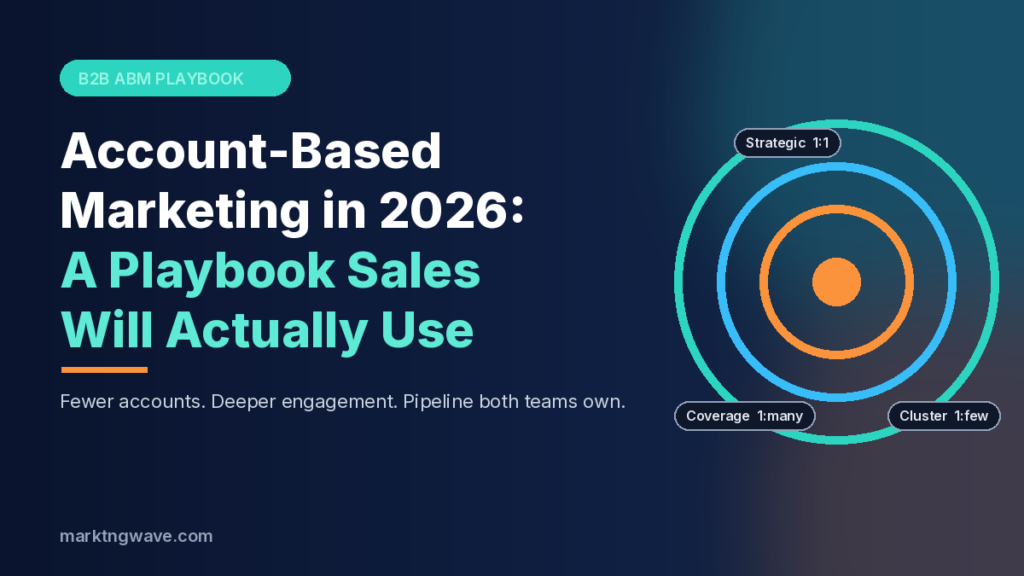
Most teams run a mix of three service levels, often at the same time:
| Dimension | One-to-one | One-to-few | One-to-many |
|---|---|---|---|
| Account set | A small list of strategic accounts | Clusters that share a vertical, use case or trigger | A defined, broader target list |
| Personalization | Custom insight, executive engagement and a named account plan | Tailored but repeatable plays for the cluster | Account-level ads, content and outreach with shared messaging |
| Sales involvement | Dedicated account team, weekly joint planning | Named owners and a standard playbook | Signal-based follow-up and clear SLAs |
| Best use | Flagship logos, renewals and large expansions | A repeatable motion in a priority segment | Efficient coverage of the rest of the ICP |
| Main risk | Too many “strategic” accounts, so nothing is truly custom | Clusters that are similar only on paper | Sliding back into generic demand generation |
The ITSMA and Demandbase research also shows where the value often appears first: marketers cited growing business with existing customers (49%) as the top benefit, followed by customer retention (44%) and brand building (41%). ABM is as much a land-and-expand and retention motion as it is a new-logo engine.
How to build an ABM program sales will run with
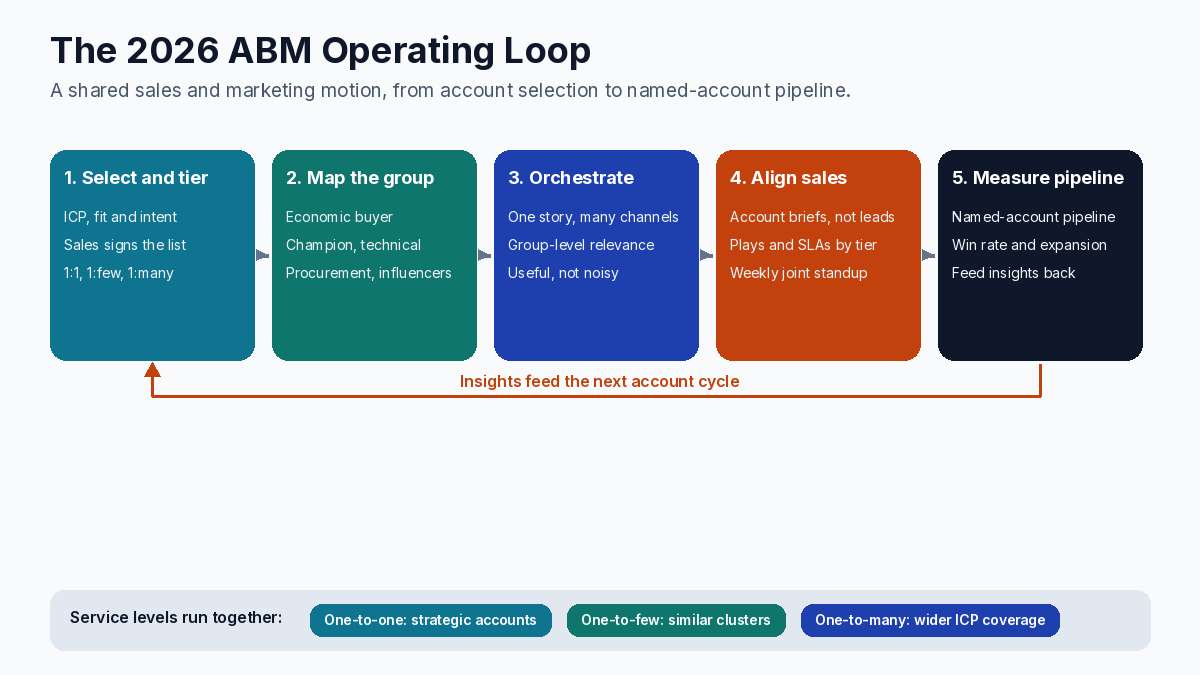
1. Choose accounts with sales, not for sales
Write down your ideal customer profile, then score a universe of accounts on fit, such as industry, size, technology stack and geography, and on opportunity, such as white space, renewal risk or expansion potential. Add intent and engagement signals so in-market accounts rise on the list, but do not let a research spike override a poor-fit company. Sales leadership should sign the final list and the tiers. If they did not help choose the accounts, they will not work them.
If you need a structured way to combine fit, intent and engagement, our guide to predictive lead scoring for B2B shows how to turn those signals into a model both teams can trust. Apply it at the account level, not just the individual lead.
2. Tier the work so effort matches revenue potential
One-to-one should be small enough that marketing can produce custom insight and sales can run a named account plan. One-to-few should group accounts that share a problem, industry or trigger event, so you can reuse a play without pretending every account is unique. One-to-many should still be a defined list, not the entire database. Publish the criteria, review the list on a set cadence, and allow accounts to move up or down as signals change.
3. Map the buying group, not just the champion
For every priority account, identify the likely roles: economic buyer, champion, technical evaluator, procurement, and the quieter influencers who can stall a deal. Use your CRM, website behavior, intent data and sales notes. You will not have a complete map on day one. The point is to stop marketing to a single contact as if they were the company.
4. Orchestrate plays around the group
Coordinate ads, web personalization, content, events and sales outreach so the account hears one story. Follow Gartner’s caution: make the message relevant to the buying group and the organization, not only to one persona. A security review one-pager for the technical evaluator, a commercial case for the economic buyer and a shared workshop for the group will do more than five “personalized” emails that never mention the same problem.
Keep outreach useful. Because so many buyers prefer a self-serve path, your site, analyst coverage and proof points have to do a lot of the early work. Sales should enter when the account needs help comparing options, building consensus or navigating risk, not only when a form fill happens to appear.
The Demand Gen Report 2025 ABM Benchmark Survey found email and in-person events remain workhorse channels, used by 92% and 72% of practitioners respectively, and that 40% of teams have already integrated ABM with demand generation. Use demand gen to create awareness in the category, then concentrate ABM resources on the accounts you have agreed to win.
5. Give sales a play, an SLA and a reason to care
ABM dies when marketing runs “account campaigns” and sales keeps working a personal lead queue. For each tier, define what marketing will deliver, what sales will do in response, and how quickly. Share account briefs, not just leads. Hold a short weekly standup on one-to-one and one-to-few accounts. Credit both teams for pipeline created from the named list.
6. Measure accounts and opportunities, not MQLs
The metrics that matter are coverage of the buying group, account engagement, meetings and opportunities in the named list, pipeline and win rate, cycle time, and expansion in existing accounts. Demand Gen Report found proving ROI (47%) and sales and marketing alignment (43%) are still the top challenges, followed by scaling (40%). You will not solve ROI with a last-touch MQL dashboard. Measure at the account and opportunity level, and use holdouts where you can. Our guide to B2B marketing attribution covers how to combine multi-touch views, mix models and incrementality tests so finance can trust the numbers.
Checklist: is your ABM program real?
- Sales and marketing jointly own the account list and the tiers.
- Every one-to-one and one-to-few account has a buying-group map, even if it is incomplete.
- Plays are coordinated across channels and written for the group, not only a persona.
- Outreach is relevant enough that it would not be among the messages buyers avoid.
- Sales has a defined follow-up play and SLA for each tier.
- Reporting starts with named-account pipeline, win rate and expansion, not lead volume.
- The list is reviewed on a fixed cadence, and accounts can move between tiers.
- Existing customers are in the program, not only new logos.
Our take: stop launching ABM as a campaign
The reason so many ABM programs stall is that they are treated as a marketing campaign with a tighter audience. Campaigns end. Account plans do not. The teams that get the return ITSMA’s respondents describe treat ABM as an operating system: a living list, a buying-group view, a small set of repeatable plays and a weekly habit with sales. AI can help with research, briefing and content drafts, but the ITSMA and Demandbase survey still put average AI maturity in ABM at just 2.3 out of 5. Tools will not fix an unsigned account list or a measurement model sales ignores.
The other shift for 2026 is timing. If buyers already have a favorite before the first meeting, ABM’s job is to earn a place on that shortlist months earlier, through useful content, consistent proof and a quiet, relevant presence in the accounts that matter. That is slower than a lead-gen sprint, and much harder to fake.
Key takeaways
- Account-based marketing is now mainstream, but a target list plus ads is not a program.
- Buyers often shortlist vendors before any sales conversation, so influence has to start earlier.
- Personalize for the buying group and the account, not only the individual contact.
- Tier the work, and let sales co-own the list.
- Measure named-account pipeline, win rate and expansion, not MQL volume.
FAQ
What is account-based marketing?
Account-based marketing is a B2B strategy in which marketing and sales focus coordinated resources on a defined set of high-value accounts, engage the buying group inside those accounts, and measure success in pipeline and revenue from that named list.
How is ABM different from demand generation?
Demand generation usually seeks a broad set of in-market buyers. ABM concentrates spend and effort on a named account list. Many strong teams use both: demand gen to create category demand, and ABM to win and grow the accounts that matter most.
Do I need an ABM platform to get started?
No. You need a jointly owned account list, a way to see engagement at the account level, coordinated plays and a reporting cadence. Platforms help you scale identity, advertising and insight, but they cannot replace sales alignment.
Should existing customers be in an ABM program?
Yes. In the ITSMA and Demandbase research, growing business with existing customers and improving retention were the top reported benefits. Expansion and renewal accounts often belong in one-to-one or one-to-few tiers.
How many accounts should we start with?
Start smaller than you think. A credible one-to-one motion might cover a few dozen strategic accounts, not hundreds. Add a one-to-few cluster and a tighter one-to-many list only when the first tier has a working rhythm with sales.
Stay ahead of B2B MarTech
Want practical guides on ABM, measurement, data and AI-powered marketing every week? Subscribe to Marktngwave and get new analysis delivered straight to your inbox.