Ask five B2B marketers whether they need a CDP or a CRM and you will probably get six answers. Vendors blur the line on purpose: CRMs now market “data clouds”, CDPs now promise sales insights, and both claim to be the home for your AI agents. Meanwhile the budget question has not gone away. Somebody still has to decide where customer data lives, who owns it and which tool your team actually logs into every morning.
This guide cuts through the noise. You will get plain definitions, a side-by-side comparison, a decision checklist and the questions to ask before you sign anything, all grounded in what analysts and the CDP industry itself are saying in 2026.
The short answer
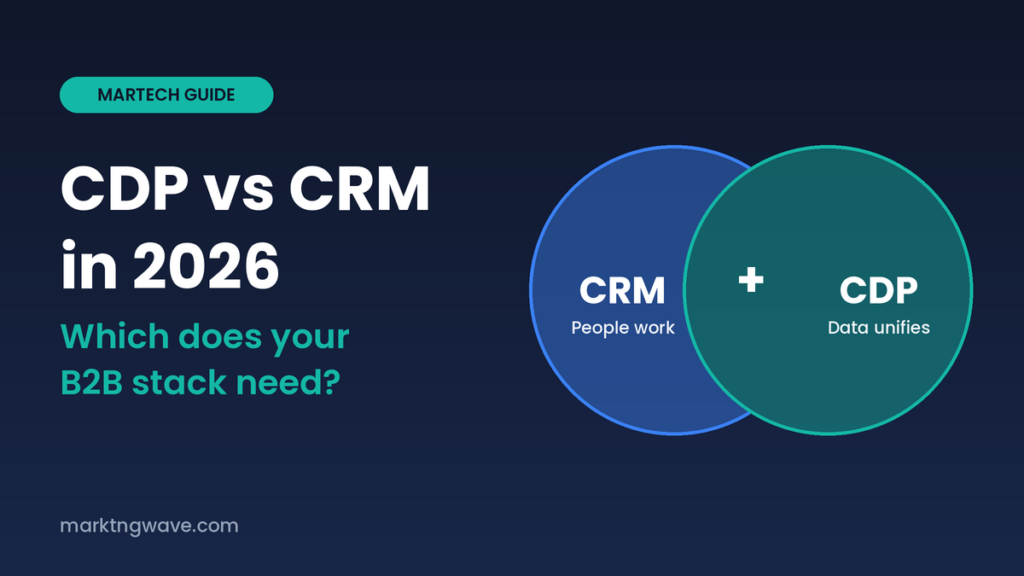
A CRM is where your people work. A CDP is where your customer data comes together. Most growing B2B companies need a CRM first, and add a CDP (or a CDP-like layer on their data warehouse) when the number of data sources, channels and personalisation use cases outgrows what the CRM can handle on its own.
The rest of this post explains how to tell when you have reached that point.
What a CRM actually does
A customer relationship management system is built around human workflows. Sales reps log calls, update deal stages and forecast pipeline. Service teams open and close tickets. Account managers check history before a renewal call. The data in a CRM is mostly created inside the CRM, often typed in by a person, and organised around accounts, contacts and opportunities.
That design is a strength for running a sales team and a weakness for marketing at scale. As the CDP Institute points out, CRMs lean heavily on manual entry and struggle to stitch together a full cross-channel journey: website visits, ad clicks, product usage and event attendance rarely land in the CRM in a clean, connected way.
What a CDP actually does
A customer data platform is built around data, not people. The CDP Institute’s current definition describes it as software that creates and maintains a persistent, unified customer record that other systems can access. In practice, a CDP does four jobs:
- Collect data from every source: website, product, email, ads, events, support tools and the CRM itself.
- Unify that data by matching identities, so the anonymous visitor, the webinar registrant and the CRM contact become one profile.
- Govern the profile: consent status, data quality, retention and who can use what.
- Activate it by pushing audiences and attributes into the tools that talk to customers, including the CRM.
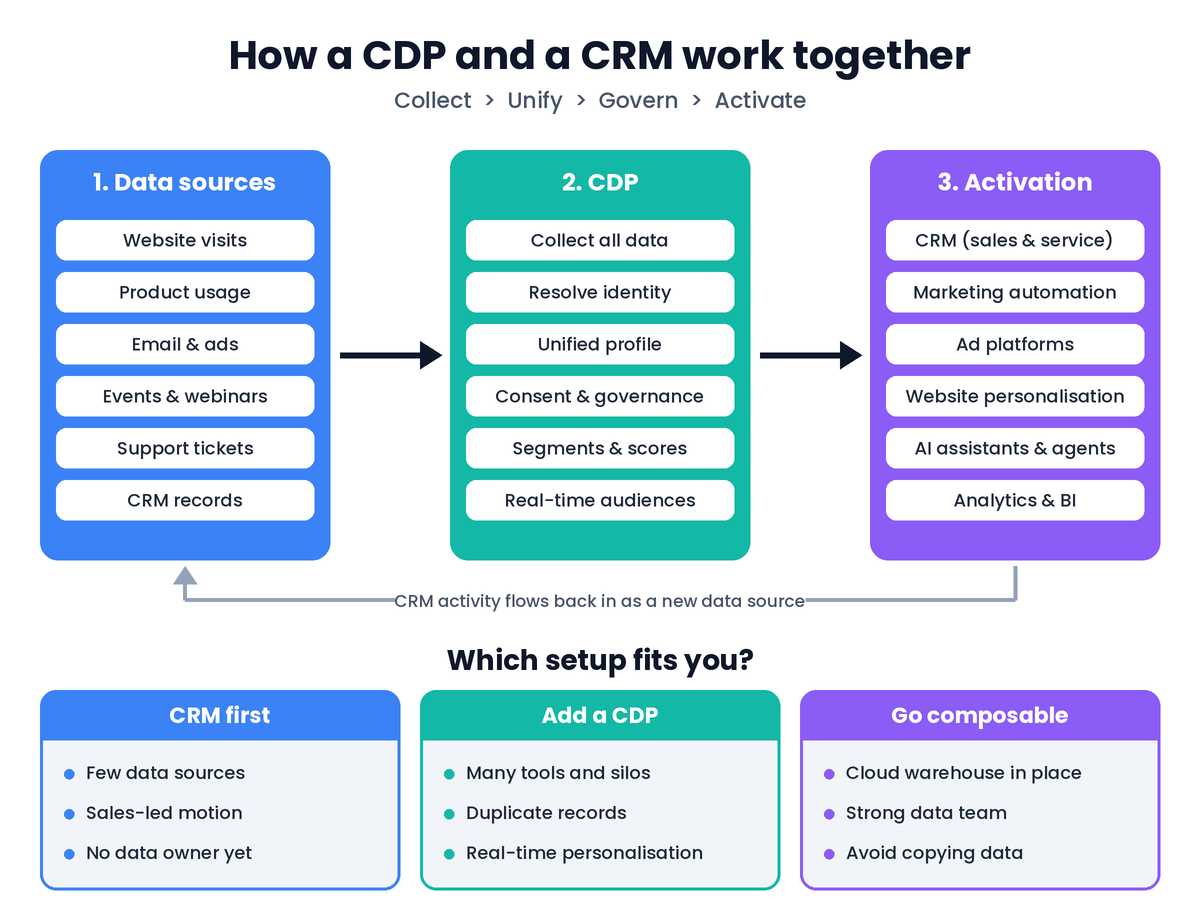
Notice that the CRM appears twice in that flow, once as a source and once as a destination. That is the key mental model: a CDP does not replace your CRM; it feeds it better data.
CDP vs CRM: side-by-side comparison
| Dimension | CRM | CDP |
|---|---|---|
| Primary users | Sales, service and account teams | Marketing ops, data and analytics teams |
| Core job | Manage relationships, deals and tickets | Build and share unified customer profiles |
| Main data sources | Mostly its own records and manual entry | Every system: web, product, ads, email, CRM, support |
| Anonymous visitors | Usually not tracked | Tracked and stitched to known profiles later |
| Unit of record | Accounts, contacts, opportunities | People (and, in B2B-ready CDPs, accounts) |
| Identity resolution | Basic de-duplication | Automated matching across channels and devices |
| Typical output | Pipeline reports, forecasts, task lists | Segments, scores and real-time audiences for other tools |
| Best for | Running a sales process | Personalisation, journey orchestration and clean data for AI |
Real-world B2B scenario: how CDP and CRM work together
Here is a concrete example. A B2B SaaS company sells to mid-market finance teams. Their stack: Salesforce CRM, HubSpot for email, a product analytics tool and Google Ads.
What the CRM sees: Sarah Chen, VP Finance at Acme Corp, has opened three nurture emails, attended one webinar and is in an active opportunity worth $48k. The sales rep logs a call note after every touchpoint.
What the CRM misses: Sarah has visited the pricing page seven times in the last two weeks, started a free trial under a personal email address, and her colleague James in IT ran two product demos anonymously. The CRM has no idea.
What a CDP adds: It stitches the anonymous trial, the IT colleague’s sessions and Sarah’s known record into one account-level profile. It passes a “high intent” signal to Salesforce, which triggers the rep to call. The rep opens the CRM and sees: “Account visited pricing 7x, trial started, second stakeholder engaged.” The call closes the deal.
The CRM ran the relationship. The CDP found the signal the CRM never would have seen on its own.
What changed in 2026
1. Almost everyone has a CDP, few use it fully
Adoption is no longer the problem. A 2024 Gartner survey, reported by Computer Weekly, found that 68% of organisations already had a CDP and another 18% were deploying one. Yet marketers used only 53% of their CDP’s capabilities on average. Gartner’s earlier Critical Capabilities research showed the same pattern a year before, with 67% adoption but only 47% of capabilities in use.
The lesson: buying a CDP is easy. Getting value from it depends on having clear use cases, clean inputs and a team that owns it.
2. The warehouse moved to the centre
The biggest architectural shift is the rise of warehouse-native, or “composable”, CDPs that sit on top of a data warehouse such as Snowflake, BigQuery or Databricks instead of copying data into their own store. The CDP Institute’s latest industry update reports that more than 25% of CDPs now support a warehouse-centric architecture, and that composable vendors grew 7.8%, nearly six times the industry average.
3. AI agents raised the stakes on data quality
Gartner’s January 2026 Magic Quadrant for Customer Data Platforms describes a market splitting in two directions: “platformization”, where CDPs become part of larger enterprise suites, and “agentification”, where they become the data foundation for autonomous AI agents. Either way, an AI agent that writes emails or prioritises accounts is only as good as the profile it reads. Messy, duplicated CRM data produces confidently wrong AI output.
4. Buying a CDP is now a cross-team decision
CDPs are no longer a marketing-only purchase. According to a 2025 Gartner survey of business buyers (via Computer Weekly), an average of five groups help fund a CDP purchase, with two to three shaping the requirements. If sales, IT and data are not in the room early, expect delays later.
What about Salesforce Data Cloud and HubSpot’s CDP features?
This is the question most B2B buyers ask first, and rightly so. If you are already in the Salesforce or HubSpot ecosystem, do you even need a standalone CDP?
Salesforce Data Cloud is essentially a CDP built into the Salesforce platform. It ingests data from outside Salesforce, resolves identities and builds unified profiles — all inside the ecosystem you already pay for. The trade-off: it works best when most of your data already lives in Salesforce products, and it is expensive at enterprise scale. For teams deeply committed to the Salesforce suite, it is a strong option that avoids the integration tax of a separate vendor.
HubSpot has expanded its data capabilities with behavioural tracking, custom objects and audience segmentation that overlap significantly with entry-level CDP features. For SMB and lower mid-market B2B teams, HubSpot’s native features may be sufficient without a dedicated CDP.
When to look at standalone CDPs instead: If you use multiple CRMs, have a data warehouse already, need to unify data from sources outside your CRM vendor’s ecosystem, or want composable architecture on Snowflake, BigQuery or Databricks — then purpose-built platforms like Segment (Twilio), mParticle, Treasure Data or RudderStack give you more flexibility and usually better data governance controls.
The honest answer: for most B2B teams under 50,000 contacts in a single CRM ecosystem, start with what your CRM vendor offers. Revisit standalone options when the ecosystem walls become constraints.
CDP vs CRM vs DMP: the three-way comparison
A data management platform (DMP) often gets pulled into this conversation. Here is how all three differ:
| Dimension | CRM | CDP | DMP |
|---|---|---|---|
| Primary purpose | Manage relationships and pipeline | Unify first-party data into persistent profiles | Build anonymous audiences for advertising |
| Identity type | Known contacts only | Known + anonymous, stitched | Anonymous IDs and cookies |
| Data duration | Long-term (full relationship) | Long-term (years) | Short-term (90–180 days) |
| Main use case | Sales execution, account management | Personalisation, journey orchestration, AI data layer | Programmatic ad targeting |
| Relevance in 2026 | Core — everyone needs one | Growing — especially for AI use cases | Declining — third-party cookie deprecation and privacy laws have reduced DMP value |
For most B2B marketers, the DMP question is largely settled: third-party cookie deprecation and tightening privacy regulation have significantly reduced the value of DMPs for B2B targeting. Focus on CRM and CDP.
When a CRM alone is enough
- You sell to a defined list of accounts and most interactions happen through sales and email.
- You have a handful of data sources and your CRM already connects to them natively.
- Your marketing is mostly campaigns and nurture flows, not real-time personalisation.
- You do not yet have someone who can own a data platform day to day.
When it is time to add a CDP
- You have product usage, website, event and ad data that never reaches sales in a usable form.
- The same buyer exists as three or four different records across tools.
- You want to personalise the website, ads and in-app messages based on behaviour, not just CRM fields.
- Your team spends more time exporting and re-uploading CSV files than running campaigns.
- You are rolling out AI assistants or agents and need a trustworthy, consented customer profile for them to read.
Step-by-step checklist: choosing the right setup
- List your top five use cases. Write them as outcomes, for example “alert reps when a target account visits the pricing page three times”. Tools come later.
- Map your data sources. Note where each one lives today, who owns it and whether it already syncs with your CRM.
- Audit your CRM data quality. Check duplicate rates, missing fields and stale contacts. A CDP will expose these problems, not hide them.
- Check your warehouse maturity. If your company already centralises data in a cloud warehouse, shortlist composable, warehouse-native options. If not, a packaged CDP may be faster.
- Look at what your CRM vendor already offers. Many CRM suites include CDP features. Compare them honestly against standalone tools for your use cases.
- Confirm B2B support. Ask vendors to demo account-level profiles, buying committees and account scoring, not just consumer examples.
- Bring in sales, IT and legal early. Agree on ownership, consent rules and success metrics before the contract.
- Start with one use case and a 90-day pilot. Prove value, then expand. This is the best defence against using half of what you paid for.
Key takeaways
- CRM = where your people work; CDP = where your customer data comes together. They complement each other.
- Most B2B teams need a CRM first and add a CDP when data sources, channels and personalisation needs grow.
- Adoption is high but usage is low: plan use cases and ownership before you buy.
- Warehouse-native (composable) CDPs are the fastest-growing segment, so check your warehouse before choosing.
- AI agents make unified, consented data more important, not less.
A CDP is also the engine behind modern marketing automation. For the bigger picture, read our guide to marketing automation trends every CMO should know in 2026. And because a CDP only pays off when sales actually uses the insights, our piece on sales and marketing alignment for B2B revenue growth is a useful companion.
Frequently asked questions
Can a CDP replace a CRM?
No. A CDP does not manage deals, forecasts, tasks or support tickets. It feeds cleaner, richer data into the CRM so sales and service teams can act on it.
Do small B2B companies need a CDP?
Usually not at first. If you have a few data sources and a modern CRM with marketing automation, start there. Revisit the question when data silos and duplicate records begin to slow your team down.
What is a composable CDP?
A composable or warehouse-native CDP adds identity resolution, segmentation and activation on top of your existing data warehouse instead of storing a separate copy of your customer data. It suits companies that already have a strong data team and warehouse.
Is a CDP the same as a DMP?
No. According to the CDP Institute, a DMP mostly builds anonymous advertising audiences from third-party data kept for limited periods, while a CDP works mainly with a company’s own data about identified people.
How long does a CDP take to show results?
That depends on your data and team, but the safest approach is a focused pilot on one use case with a clear metric, rather than a big-bang rollout across every channel.
Conclusion
The CDP vs CRM debate is really a question of roles. Let your CRM run relationships, let a CDP (packaged or composable) unify and govern the data, and let your use cases, not vendor demos, decide when to make that jump. Get the foundations right now and every AI tool you add next year will work better for it.
Want practical MarTech guides like this in your inbox? Subscribe to Marktngwave for new strategy breakdowns, tool comparisons and AI-powered marketing playbooks every week.