AI-Powered Lead Scoring: Beyond Traditional Metrics
Somewhere in your CRM right now, a lead with a “Director” title and three whitepaper downloads is sitting at a score of 85. Sales is ignoring it. Meanwhile, a lead with a vague title and a single visit to your pricing page, followed by a return trip the next morning, sits at 22. That one is about to sign with your competitor.
This is the quiet failure of rules-based lead scoring, and it’s why AI-powered lead scoring has moved from “interesting pilot” to a standard feature in the big platforms. Salesforce (Einstein), HubSpot (predictive lead scoring), Adobe Marketo Engage, and a crowd of specialists like 6sense, Demandbase and MadKudu now offer models that learn from closed-won and closed-lost data instead of relying on points someone assigned in a conference room in 2019. The pitch is simple: stop guessing which behaviors matter and let the data tell you. The reality is a little more complicated, and more interesting.
How We Got Here
The points game
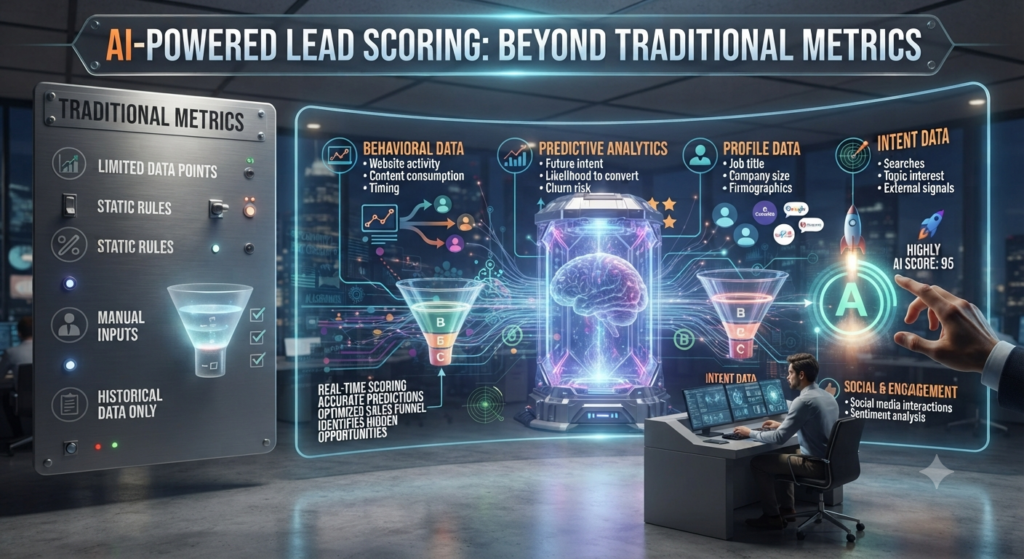
Traditional scoring is easy to explain. Ten points for opening an email. Twenty for a webinar. Fifty for requesting a demo. Add points for job title and company size, subtract some for a Gmail address, and set an MQL threshold at 100. Marketing hands over everything above the line.
It worked well enough when buying journeys were shorter and the signals fewer. But it has some built-in problems:
- The weights are opinions. Somebody decided a webinar was worth twice an email open. Nobody tested it.
- It rewards activity, not intent. A student downloading every ebook you’ve published will outscore a buyer who read one page, the right one.
- It decays badly. Markets shift, products change, and the model stays frozen until someone has time to revisit it. Spoiler: nobody has time.
- It ignores the account. In B2B, deals are bought by committees. Scoring a single contact in isolation misses the six other people from the same company quietly reading your blog.
What changed
Two things made better scoring possible. First, data got richer: product usage, intent signals from third parties, ad engagement, and conversation data from sales calls all now sit within reach of a CRM or customer data platform. Second, machine learning on tabular business data got cheap and reasonably dependable. You no longer need a data science team to train a model on your last 2,000 opportunities. Often you just need to switch a feature on and have clean enough data to feed it.
What AI Scoring Actually Does Differently
Strip away the vendor language and most predictive scoring does three things.
It finds patterns you didn’t think to look for. Maybe leads who visit your integrations page within a week of first contact close at three times the average. Maybe attendance at a live webinar means almost nothing, while on-demand views mean a lot. A human could find these, but rarely does, because nobody’s job is to run that analysis every month.
It weighs signals in combination. A VP-level contact at a 500-person company is interesting. The same contact, from a company that just posted four relevant job openings and has two colleagues already engaging with your content, is a different conversation entirely. Models handle these interactions far better than additive points.
It updates. Retrain on fresh outcomes and the model adjusts as your market does. That alone is worth something, given how many scoring models in the wild are older than some of the interns.
A concrete scenario
Picture a mid-market SaaS company selling workflow software. Under its old system, anyone who downloaded two gated assets and held a manager title became an MQL. Sales accepted about a third of them and closed a sliver.
After feeding 18 months of closed deals into a predictive model, the team found that the strongest predictors were repeat visits to the pricing and security pages, multiple contacts from the same domain engaging within 30 days, and use of a free trial’s collaboration features. Ebook downloads barely registered. They rebuilt their handoff around those signals. Fewer leads reached sales, but a higher share were worth a call. Sales stopped rolling its eyes at the weekly MQL report, which, as anyone in the business knows, is its own kind of victory.
That’s an illustration, not a benchmark, but it reflects the pattern many teams describe.
What This Means for B2B Marketers
Your data hygiene is now your strategy
A model is only as good as what it learns from. If your CRM has inconsistent opportunity stages, missing close reasons, or duplicate accounts, the AI will faithfully learn your mess. Before you buy anything, audit how consistently outcomes are recorded. It’s unglamorous work, and it’s where most of the value is decided.
Volume matters more than people admit
Predictive models need enough closed deals to find real patterns. If you close 15 deals a year, a model will mostly be inventing stories. Smaller teams are often better served by a simpler, well-audited rules-based approach, or by account-level intent tools, than by a predictive model with too little to chew on. HubSpot and Salesforce both publish minimum data guidance for their predictive features. Read it before you get excited.
Shift from lead scoring to account scoring
If you sell to buying committees, scoring individuals alone is a half-measure. Pair contact-level fit and engagement with account-level signals: aggregate engagement, hiring trends, technology installs, and third-party intent. This is where platforms like 6sense and Demandbase have built their pitch, and where the native CRM tools are catching up.
Rethink the handoff
A better score doesn’t help if the process around it hasn’t changed. Define what sales does with a hot lead, how quickly, and what happens when a score drops. Otherwise you’ve built a faster way to generate unread alerts. For more on aligning the two teams, see [INTERNAL: article about sales and marketing alignment].
Expert Analysis: The Caveats Worth Taking Seriously
Practitioners who’ve run these systems tend to raise the same few concerns, and they’re worth taking seriously.
- Black-box discomfort. If sales asks “why is this lead a 92?” and the answer is “the model says so,” trust evaporates fast. Look for tools that show the top contributing factors for each score. Transparency isn’t a nice extra here; it’s adoption insurance.
- Self-reinforcing bias. A model trained on who you’ve historically closed will favor more of the same. If your past customers skew toward one industry or company size, the model may quietly deprioritize the segment you’re trying to break into. Review scoring outcomes against your growth goals, not just your history.
- Privacy and signal loss. Cookie deprecation timelines have shifted repeatedly at Google, but the direction of travel is clear, and regulations like GDPR limit what behavioral data you can collect and use. Models that rely heavily on third-party tracking are built on shaky ground. First-party data, meaning your own site, product and CRM, is the safer foundation. See [INTERNAL: article about first-party data strategy] for how to build it.
- Vendor claims. Case studies promising double-digit conversion lifts are common and rarely comparable. Ask for results from companies with a similar sales cycle and deal volume, and run your own test against your current model before replacing it.
A sensible way to test
Run the AI score alongside your existing one for a quarter. Don’t switch anything off. Compare how each performs on the question that matters: of the leads each model flagged as hot, how many became real opportunities, and how fast? If the new model wins, you’ll have evidence. If it doesn’t, you’ll have saved yourself a painful migration.
What to Watch
- Generative AI inside the CRM. Salesforce, HubSpot and Microsoft are all adding assistants that summarize account activity and suggest next steps. Scoring is likely to become less a number and more a short written explanation of why a lead matters.
- Conversation data as a signal. Call transcripts and email threads are increasingly feeding models. A prospect asking about contract terms says more than a dozen page views.
- Ad platform integration. Expect tighter loops between scores and audience building on Google and Meta, so high-scoring accounts get different ad treatment than cold ones. Done well, it’s efficient. Done carelessly, it’s creepy, so mind your frequency caps.
- Regulatory pressure. Automated profiling is a regulatory focus in several regions. Documenting how your scoring works now is cheaper than reconstructing it later.
- Consolidation. Standalone scoring vendors face pressure as CRMs absorb their features. If you’re buying a point solution, check how long its differentiation is likely to last.
The Bottom Line
AI scoring isn’t magic, and it won’t rescue a broken funnel. What it does well is replace guesswork with evidence, provided you feed it clean data and enough outcomes to learn from. Start with an audit, run a side-by-side test, insist on explanations you can show to sales, and keep an eye on who your model quietly leaves out. Do that, and you’ll likely end up with a handoff process people trust. That’s rarer than it should be.
Want more insights like this? Subscribe to Marktngwave.