Ask five B2B marketers which channel drove last quarter’s pipeline and you will often get five different answers, each backed by a different dashboard. The ad platforms claim the conversions, the marketing automation tool credits the last email, the CRM says the deal was “sales sourced,” and the CFO trusts none of it. In 2026, the fix is not a better single model. It is a measurement stack that uses B2B marketing attribution, marketing mix modeling (MMM) and incrementality testing for the jobs each one is actually good at.
This guide explains how the three methods differ, where each breaks down in long, committee-driven B2B deals, and how to combine them into a system your revenue team will believe.
Why B2B attribution keeps breaking
Classic multi-touch attribution (MTA) was designed for a single buyer clicking through a trackable path. B2B buying looks nothing like that. Gartner describes buying groups ranging from five to 16 people across as many as four functions, and a separate Gartner survey found that 61% of B2B buyers prefer a rep-free buying experience. Most of that self-directed research happens in places your tracking never sees: peer communities, podcasts, analyst reports, private Slack groups and, increasingly, AI assistants.
The 6sense 2025 B2B Buyer Experience Report, based on just under 4,000 buyer responses, adds a sharper problem: buyers typically rank their shortlist before contacting any vendor, and most of them reach out first rather than waiting to be contacted. By the time a form fill appears in your CRM, much of the decision has already been shaped by touches no pixel recorded.
Layer on cookie restrictions, consent requirements, link-stripping in email and the rise of zero-click answers, and user-level attribution captures a shrinking slice of reality. That does not make it useless. It makes it partial, and the mistake is treating a partial view as the whole truth.
The three measurement methods, explained
Multi-touch attribution (MTA)
MTA assigns fractional credit to recorded touchpoints such as ad clicks, email engagement, webinar attendance and site visits. In B2B it only works when activity is rolled up to the account or opportunity, not the individual lead. Its strength is speed and granularity: it can tell a demand gen manager which campaigns, keywords and creatives are associated with opportunity creation this week. Its weakness is that recorded credit is not cause. A retargeting ad that shows up in every winning journey may simply be following buyers who were going to convert anyway.
Marketing mix modeling (MMM)
MMM works on aggregate data instead of user journeys. It relates weekly or monthly spend and activity by channel, plus outside factors such as seasonality, pricing and macro conditions, to an outcome like pipeline or revenue. Because it needs no cookies or identifiers, it is resilient to privacy changes and can include channels that never produce a click, such as events, podcasts or connected TV. Google made its Bayesian MMM, Meridian, available to everyone as open source in January 2025, which has lowered the cost of trying MMM in-house. The trade-off is data hunger: you need a meaningful run of consistent history and real variation in spend for the model to learn anything.
Incrementality testing
Incrementality asks the only question that proves causation: what happened because of this marketing that would not have happened otherwise? You answer it with experiments, such as geo holdouts, audience holdouts, or pausing a channel in a controlled way and comparing results against a control group. Tests are slower and narrower than models, but they are the ground truth you use to check whether your attribution and MMM outputs deserve belief.
MTA vs MMM vs incrementality: a side-by-side comparison
| Dimension | Multi-touch attribution | Marketing mix modeling | Incrementality testing |
|---|---|---|---|
| Core question | Which recorded touches are associated with pipeline? | How does pipeline respond to spend by channel? | Did this activity cause additional pipeline? |
| Data needed | Account-level touchpoints, identity resolution, CRM opportunities | Aggregate spend, activity and outcomes over time, plus external factors | A test design, a clean control group and enough volume |
| Best decision | Weekly campaign, keyword and creative optimization | Quarterly and annual budget allocation, scenario planning | Validating a specific channel, tactic or budget bet |
| Privacy resilience | Low to medium | High | High |
| Main B2B weakness | Misses dark-funnel influence; credit is not causation | Needs history and spend variation; less useful for tactical tweaks | Long sales cycles and small volumes make tests slow |
| Typical owner | Marketing ops, demand gen | Analytics, finance, CMO | Analytics or RevOps with channel owners |
How to build a B2B measurement stack in 2026
1. Fix the data layer first
Every method depends on clean, joined data. Agree on one taxonomy for channels and campaigns, enforce UTM and naming conventions, connect ad platform spend exports to your CRM and marketing automation records, and make sure contacts roll up to accounts and opportunities reliably. If your customer data is scattered, our guide to CDP vs CRM for B2B stacks covers where each system should sit.
2. Move attribution to the account and opportunity level
Stop crediting leads and start crediting pipeline. Attach touches to the opportunity’s buying group, measure opportunity creation and progression rather than form fills, and report sourced and influenced pipeline with definitions that sales and finance have signed off. Account-level views also pair naturally with scoring: if you are rebuilding qualification, see our walkthrough on predictive lead scoring for B2B.
3. Add self-reported attribution
A single required “How did you hear about us?” field on demo and contact forms, with free text rather than a dropdown, regularly surfaces channels your tracking misses: a podcast episode, a LinkedIn creator, a peer recommendation or an AI assistant answer. It is noisy and biased, but it is the cheapest window into the dark funnel. Have sales confirm it on the first call and store it on the opportunity.
4. Introduce MMM when you have the history
Once you have a sustained record of weekly spend and pipeline by channel, an MMM can estimate channel contribution and diminishing returns. B2B teams should model a pipeline metric, such as qualified opportunities or pipeline value, rather than closed revenue alone, because long cycles blur the signal. The IAB’s December 2025 guidance on modernizing MMM pushes for more frequent refreshes and for models that fold in experimental results, which is exactly what B2B teams need.
5. Run incrementality tests on your biggest bets
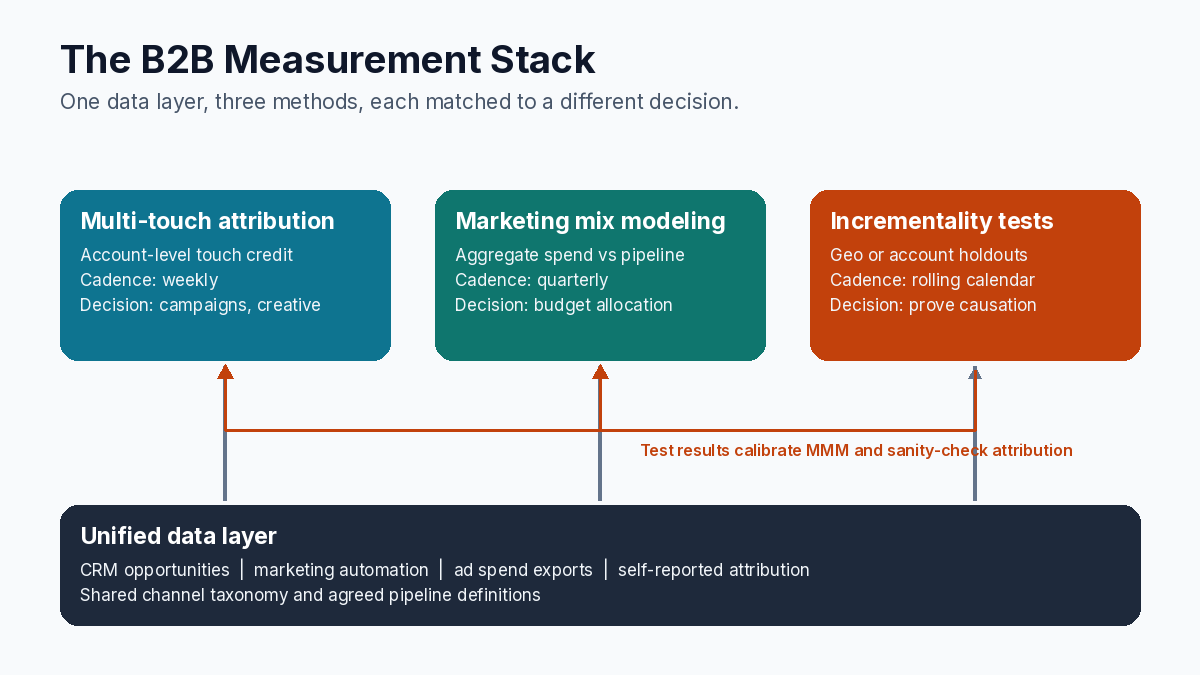
Pick the one or two channels with the largest budget or the most internal debate, often paid social, branded search or retargeting, and design a holdout. Geo splits work when you sell across regions; account-list holdouts work well for ABM programs. Run long enough to observe opportunity creation, not just engagement. Then feed the result back into your MMM as a prior and use it to sanity-check attribution credit.
6. Set a reporting cadence and governance
Use MTA weekly for in-channel optimization, MMM quarterly for budget planning, and a rolling test calendar for validation. Publish a short measurement charter that lists definitions, data owners and which method answers which question, so debates shift from “whose number is right” to “which tool fits this decision.”
Checklist: is your B2B measurement trustworthy?
- Channel and campaign taxonomy is documented and enforced across every platform.
- Ad spend data lands in the same warehouse or CRM as opportunities.
- Touches roll up to accounts and opportunities, not just leads.
- Sourced and influenced pipeline definitions are agreed with sales and finance.
- A self-reported attribution field is live on high-intent forms.
- At least one incrementality test has been completed in the last two quarters.
- MMM, if used, is refreshed on a set schedule and calibrated with test results.
- Leadership reviews pipeline contribution, not clicks or MQL counts.
Our take: stop shopping for the “right” model
The biggest measurement mistake we see in B2B is buying an attribution tool and expecting it to settle budget debates. No single model can, because each answers a different question. Attribution is a steering wheel for the people running campaigns. MMM is the map finance uses to plan the trip. Incrementality tests are the road signs that tell you whether both are pointing the right way. Teams that accept this stop arguing about which dashboard wins and start making faster, more defensible budget calls.
Forrester’s analysis of Meridian makes a related point: a free, open-source model is not a one-size-fits-all solution. Tools have become cheaper, but the hard part, clean data, agreed definitions and the discipline to run tests, is still organizational work. That is also where the advantage lies, because competitors cannot download it from GitHub.
Key takeaways
- B2B buying groups and self-directed research mean user-level attribution sees only part of the journey.
- Use MTA for weekly tactics, MMM for budget allocation and incrementality tests to prove cause.
- Measure at the account and opportunity level, and report pipeline contribution to leadership.
- Self-reported attribution is the cheapest way to see dark-funnel channels.
- Clean, unified data and shared definitions matter more than any specific vendor.
FAQ
What is the best attribution model for B2B?
There is no single best model. For tactical optimization, account-based multi-touch attribution tied to opportunities works well. For budget allocation, marketing mix modeling is more reliable. Incrementality tests validate both.
Is multi-touch attribution dead?
No, but its role has narrowed. Privacy changes and dark-funnel research mean it captures less of the journey, so it should guide in-channel decisions rather than overall budget splits.
Can small B2B teams use marketing mix modeling?
Open-source options such as Google’s Meridian have lowered the cost, but MMM still needs a consistent history of spend and outcomes with real variation. Smaller teams often start with self-reported attribution and simple holdout tests first.
How long should a B2B incrementality test run?
Long enough to observe the outcome you care about, usually opportunity creation rather than clicks. That depends on your sales cycle and volume, so plan tests around your typical time from first engagement to opportunity.
What should I report to the board?
Report marketing-sourced and influenced pipeline and revenue using definitions agreed with sales and finance, supported by MMM-based budget scenarios and recent test results. Our article on B2B marketing metrics CEOs care about goes deeper.
Stay ahead of B2B MarTech
Want practical guides on measurement, data and AI-powered marketing every week? Subscribe to Marktngwave and get new analysis delivered straight to your inbox.