
Most B2B lead scores fail quietly. Marketing celebrates a rising MQL count, sales ignores the list, and nobody can explain why a “92-point lead” never answered a call. The problem is rarely scoring itself. It is a model built on guesses, never checked against real outcomes, and never trusted by the people meant to act on it.
This guide shows how to build a predictive lead scoring model in 2026 that reflects how B2B buying works today, and that sales will actually use.
Why Rules-Based Lead Scoring Breaks Down
Classic scoring assigns points by hand: ten for a webinar, five for an email click, twenty for a director title. It is easy to launch and easy to explain, but it decays fast for three reasons.
- The weights are opinions. Someone decided a whitepaper download was worth fifteen points. Almost nobody goes back to test whether that was true.
- Buyers no longer leave a clean trail. Gartner reports that 67% of B2B buyers prefer a rep-free experience, and 45% of the 646 buyers it surveyed used AI during a recent purchase. Much of the research happens where your forms and tracking pixels never see it.
- One person is not the buyer. Forrester’s Buyers’ Journey Survey, 2025 found that 73% of purchases involve three or more departments, with an average of 13 people inside the buying organization and nine outside it. Scoring a single contact misses most of the decision.
The result is score inflation: busy but irrelevant contacts climb to the top, while a quiet economic buyer at a perfect-fit account stays invisible.
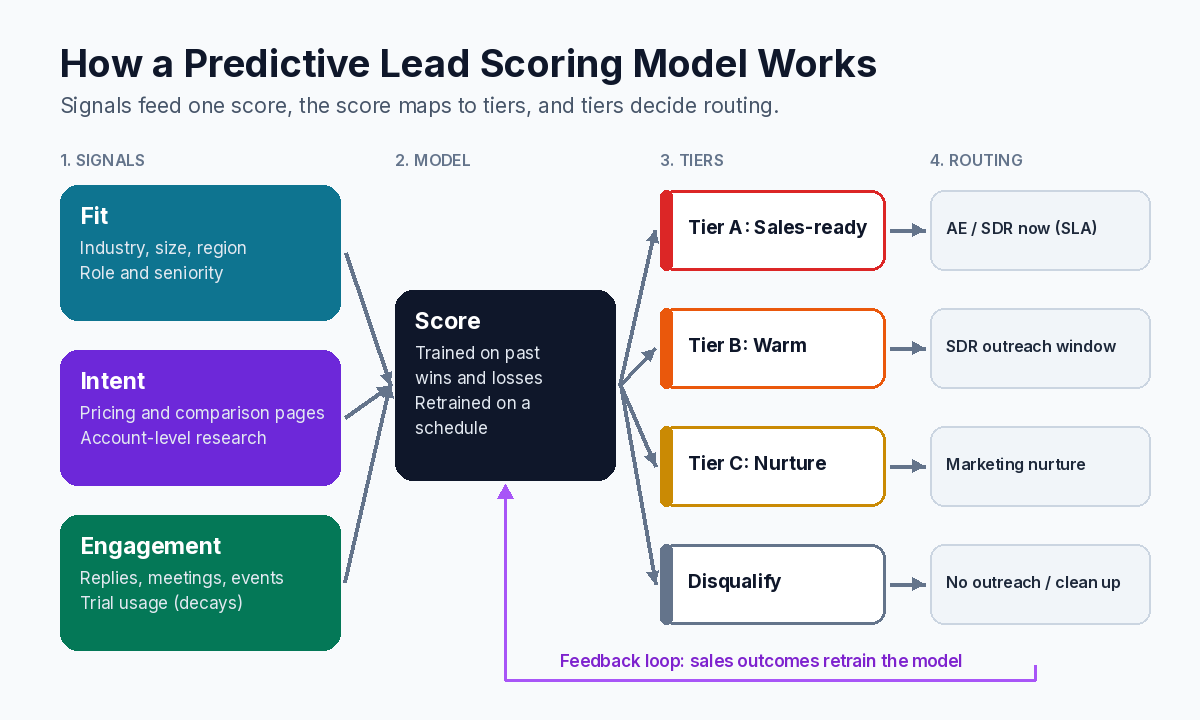
Fit, Intent, and Engagement: The Three Signal Families
A trustworthy model separates signals by what they tell you, instead of blending everything into one opaque number too early.
Fit signals: “Should we sell to them?”
Firmographic and technographic attributes such as industry, employee count, revenue band, region, tech stack, and the contact’s role and seniority. Fit changes slowly and is the best guard against chasing busy but unqualified leads.
Intent signals: “Are they in market?”
Evidence that an account is researching your category: visits to pricing or comparison pages, anonymous company-level website traffic, third-party topic research, review site activity, or hiring patterns that suggest a project. Intent is often account-level and time-sensitive.
Engagement signals: “Are they engaging with us?”
First-party interactions such as email replies, meetings booked, event attendance, product trial usage, and content consumption. Engagement should decay over time, because a demo request from last week means far more than one from last year.
Keeping these dimensions visible makes the score explainable: a rep can tell “great fit, low activity” (outbound candidate) from “high activity, poor fit” (nurture, not a call).
From Leads to Accounts: Scoring the Buying Group
Because decisions are made by committees, the most useful score in 2026 is often the account score, not the contact score. Account-level scoring rolls up the signals from every known person at a company and asks a different question: is this buying group forming, and do we have the right roles engaged?
Practical ways to build it:
- Map the roles that typically appear in your won deals (for example, economic buyer, technical evaluator, end-user champion, procurement).
- Give credit for breadth: three engaged roles at one account usually beat one hyperactive contact.
- Combine account fit with account-level intent, then use contact scores to decide who sales should call first.
- Flag coverage gaps, such as high intent but no known decision-maker, so marketing and SDRs can fill them.
Predictive Scoring in Common CRMs: What the Platforms Actually Do
Most major CRMs now include machine-learning scoring. The details matter, because each one predicts a slightly different outcome and has different data requirements.
- HubSpot calculates a Likelihood to close property, the probability that a contact becomes a customer within 90 days, and a Contact priority property that splits contacts into tiers of 25% each. It is listed for Marketing Hub Enterprise and Sales Hub Enterprise, and HubSpot notes that the model is a black box, so you cannot see exactly how inputs turn into the score.
- Salesforce Einstein Lead Scoring ranks leads by their similarity to previously converted leads, shows the fields with the greatest influence on each score, and reanalyzes data every 10 days. Its setup considerations call for at least 1,000 leads created in the last 200 days, with at least 120 converted, before it builds a model on your own data. Below that, when scoring all leads together, it falls back to a global model built from anonymized data across many customers.
- Microsoft Dynamics 365 Sales requires at least 40 qualified and 40 disqualified leads created and closed within the training window you select, which can range from three months to two years. You can also build separate models for different regions or business units.
Each tool predicts a slightly different outcome. Confirm its definition of “success” matches yours, and check edition and licensing requirements before you rely on it.
Data Prerequisites Before You Build
Predictive models learn from history, so the history has to be usable. Check these before training anything:
- Clear outcome labels. Consistent lifecycle stages and a reliable record of which leads became opportunities and which deals closed won or lost.
- Enough positive examples. Conversions are the scarce class. A large database with very few wins produces a weak model.
- Contact-to-account association. Without it, account scoring and buying-group views are impossible.
- Clean, deduplicated records with normalized job titles and industries.
- Tracking that works. Website, email, and meeting activity should land on the right records. If you are unsure which system should own which data, our CDP vs CRM guide covers the trade-offs.
Step-by-Step: Building a Predictive Lead Scoring Model
- Define the target outcome. Pick one: sales-accepted lead, opportunity created, or closed-won within a set window. Opportunity creation is often the best balance of speed and meaning.
- Agree on the ideal customer profile with sales. Write down which segments you will and will not pursue. This becomes your fit baseline.
- Assemble a training set. Pull 12 to 24 months of leads with their fit attributes, engagement history, and final outcome. Exclude records with missing labels.
- Choose your approach. Use a built-in CRM model if you meet its data minimums, or a transparent statistical model (such as logistic regression) built by your ops or data team if you need full explainability.
- Hold out a test period. Train on older data and validate on the most recent months to see how the model performs on leads it has never seen.
- Pilot with one sales team. Run the score alongside the old process and collect rep feedback on the top and bottom of the list.
- Roll out with documentation. Publish what the score means and who owns it.
Calibration, Thresholds, and the MQL-to-SQL Handoff
A score only creates value when it triggers the right action. Convert the raw number into a small set of tiers, each with a clear owner and response expectation:
- Tier A (sales-ready): strong fit plus strong intent or engagement. Route to an account executive or SDR immediately with a defined response-time SLA.
- Tier B (warm): good fit, moderate activity. SDR outreach within an agreed window, or a targeted sequence.
- Tier C (nurture): fit but not yet active, or active but weak fit. Keep in marketing programs. Our guide to lead nurturing workflows covers how to move these leads forward.
- Disqualify: outside ICP, competitors, or invalid data.
Set thresholds based on sales capacity, not vanity. If reps can work 200 new leads a month, the Tier A cut-off should produce roughly that number. Then write the handoff into a shared SLA: response time, number of attempts, required feedback fields, and what happens to leads sales rejects. Shared definitions like these are the core of sales and marketing alignment, and they give your model the feedback it needs to improve.
Rules-Based vs Predictive vs Account-Based Scoring
| Dimension | Rules-Based | Predictive (AI) | Account-Based |
|---|---|---|---|
| How weights are set | Manually, by opinion | Learned from historical outcomes | Rolled up from contacts plus account fit and intent |
| Unit scored | Individual lead | Individual lead or contact | Company and buying group |
| Data needed | Low | Meaningful volume of labeled conversions | Contact-account mapping and intent data |
| Explainability | High | Varies by tool; some are black boxes | Medium to high if components stay visible |
| Maintenance | Frequent manual tuning | Periodic retraining and monitoring | Role mapping and coverage reviews |
| Best for | Early-stage teams, low volume | Teams with solid CRM history | Complex, multi-stakeholder deals |
Governance and Privacy
Lead scoring processes personal data, so govern it. Document which data sources feed the model and the legal basis for using them, honor opt-outs and regional privacy rules, and avoid attributes that could act as proxies for protected characteristics. Assign a named owner, usually in revenue operations, who approves model changes and keeps a change log. Finally, keep a human in the loop: the score should prioritize outreach, not automatically disqualify people from ever hearing from you.
Measuring Score Accuracy
Trust comes from evidence. Report these metrics monthly and share them with sales:
- Conversion rate by tier: Tier A should convert to opportunities at a clearly higher rate than Tier B, and B higher than C. If the tiers look the same, the model is not working.
- Coverage of wins: what share of recent closed-won deals were Tier A or B before they became opportunities.
- Sales acceptance and rejection rates, with rejection reasons.
- Drift: changes in score distribution after new campaigns, products, or markets.
Common Mistakes to Avoid
- Training on inconsistent lifecycle data, then blaming the algorithm.
- Letting raw activity outweigh fit, and never decaying engagement.
- Launching without sales input on the ICP and thresholds.
- Accepting a vendor’s default model without validating it against your own outcomes.
Key Takeaways Checklist
- Define one clear target outcome and agree on it with sales.
- Separate fit, intent, and engagement, and keep them visible.
- Score accounts and buying groups, not just individuals.
- Translate scores into tiers tied to routing rules and SLAs.
- Monitor conversion by tier monthly and retrain when performance drifts.
FAQ
How much data do I need for predictive lead scoring?
It depends on the tool. Salesforce asks for at least 1,000 leads and 120 conversions in the last 200 days for a model trained on your own data, while Dynamics 365 Sales requires at least 40 qualified and 40 disqualified leads in the training window. More labeled outcomes generally produce a more reliable model.
Should I replace rules-based scoring entirely?
Not necessarily. Many teams keep simple rules for hard disqualifiers and urgent signals, such as a demo request, and use the predictive score to rank everything else.
What is the difference between a lead score and an account score?
A lead score rates one person’s likelihood to convert. An account score rates the whole company, combining fit, intent, and the engagement of multiple buying group members.
How often should the model be reviewed?
Review tier performance monthly and revisit the model after major changes to your ICP, products, or lead sources. Automatic retraining still needs a human sanity check.
Want more practical playbooks on AI-powered B2B marketing, CRM strategy, and revenue operations? Subscribe to MarktngWave and get new guides delivered as soon as they are published.
