Lead Nurturing Workflows That Boost Sales Opportunities
Most B2B lead nurturing programs are little more than automated email check-ins that slowly burn marketing budget without moving the revenue needle. The difference between a cost-center nurture engine and one that predictably generates sales opportunities comes down to design—specifically, workflows built on buying signals, intent data, and shared marketing-sales accountability. In this article, we deconstruct the lead nurturing workflows that actually increase qualified pipeline, shorten customer acquisition cost (CAC) payback, and strengthen lifetime value (LTV). You’ll get a five-step framework for building revenue-centric nurture programs, real-world examples from B2B teams that turned their nurture into a pipeline weapon, and an honest look at where even sophisticated demand gen organizations go wrong. By the end, you’ll be able to audit your current nurturing logic not by email open rates, but by downstream sales conversations created.
Nurture Isn’t Broken—Your Workflow Is
Every B2B organization has a lead nurture program. Few have one that the sales team actually praises. Walk through a typical marketing automation instance and you’ll find long onboarding sequences, cold re-engagement drips, and content cadences that send the same white paper to everyone regardless of behavior. These are lead nurturing workflows in name only. They keep contacts warm at best; they rarely create incremental sales opportunities.
The hard truth is that nurturing has become synonymous with “keeping the lights on” instead of “accelerating pipeline.” That’s a design failure. A revenue-first lead nurturing workflow is engineered to identify when an account or contact is moving from passive consumption to active buying, then trigger a cross-functional motion that hands that signal to sales with context and timing. When done right, these workflows aren’t measured by click rates—they’re measured by pipeline revenue influenced and marketing attribution that passes CFO scrutiny.
This piece lays out the architecture for those workflows. We’ll look at the data, the structural shifts in B2B buying, and the practical steps to move from batch-and-blast nurture to an engine that the CRO views as a core growth lever.
Why Nurturing Matters More Than Ever (and Why Most Programs Miss the Mark)
B2B buying behavior has fragmented. A 2024 Demand Gen Report survey found that 61% of B2B buyers now conduct extensive research before ever speaking to a salesperson, and they consume an average of 13 pieces of content during that journey. The window for marketing to influence the deal—and for sales to enter at the right moment—is massive. Yet a study by Forrester indicates that only 21% of marketing-generated leads are actively sales-ready upon initial capture. That means the other 79% need to be nurtured, but not in the way most teams do it.
Simultaneously, the pressure to demonstrate efficient growth has never been higher. CEOs and boards are scrutinizing CAC and demanding that marketing investments show a measurable return in pipeline revenue and net-new ARR. The days when a CMO could report “we sent 50,000 nurture emails this quarter” and get a nod of approval are over. Now, the question is: “How many of those nurtured contacts entered a real sales conversation, and what was the closed-won rate?” Lead nurturing workflows, when tied to marketing attribution models, must answer that question cleanly.
Compounding the challenge, the rise of buying groups and account-level motions means that nurturing a single lead in isolation no longer makes sense. B2B deals involve an average of 6-10 decision makers, according to Gartner. If your nurture program only cares about the individual who downloaded an eBook, you’re blind to the other five people in that account who are also researching—and whose engagement signals could unlock a sales opportunity. The workflows that work today are account-aware, intent-driven, and orchestrated across channels, not confined to an email cadence.
The Shift from Drip Campaigns to Signal-Responsive Workflows
The biggest evolution in the last 12 months is the move away from fixed-sequence drips toward dynamic, trigger-based nurture architectures. Three trends power this shift:
- Intent data as the primary trigger. Third-party intent providers (Bombora, 6sense) and native platform signals (LinkedIn, G2) now feed real-time buying signals into marketing automation platforms. Leading teams use these signals to break people out of generic nurture streams and move them into a hot-path workflow that immediately alerts an SDR or launches an account-specific sales play.
- Account-based nurturing takes center stage. Instead of nurturing individual leads, revenue operations teams build workflow logic around accounts—aggregating engagement across all contacts and targeting the buying group with coordinated touches. This treats nurturing as a pipeline acceleration tactic, not a top-of-funnel activity.
- Sales and marketing co-own the nurture logic. Sales development managers now sit in the room when nurture workflows are designed. They define what constitutes a “sales opportunity” and set the rules for when marketing hands a nurtured conversation to a human. This shared definition directly improves both lead-to-opportunity conversion rates and the accuracy of marketing attribution for pipeline revenue.
“The most valuable nurture workflows don’t ‘drip’ on people. They listen, then act. The difference is the difference between a newsletter and a deal accelerator.”
The Anatomy of a Revenue-Creating Lead Nurturing Workflow
After auditing dozens of B2B nurture programs, I’ve found that the ones that consistently generate sales opportunities share five distinct components. They’re rarely implemented in full, which is why most nurture engines underperform. Here’s what excellence looks like.
1. Behavioral + Intent Scoring, Not Just Engagement
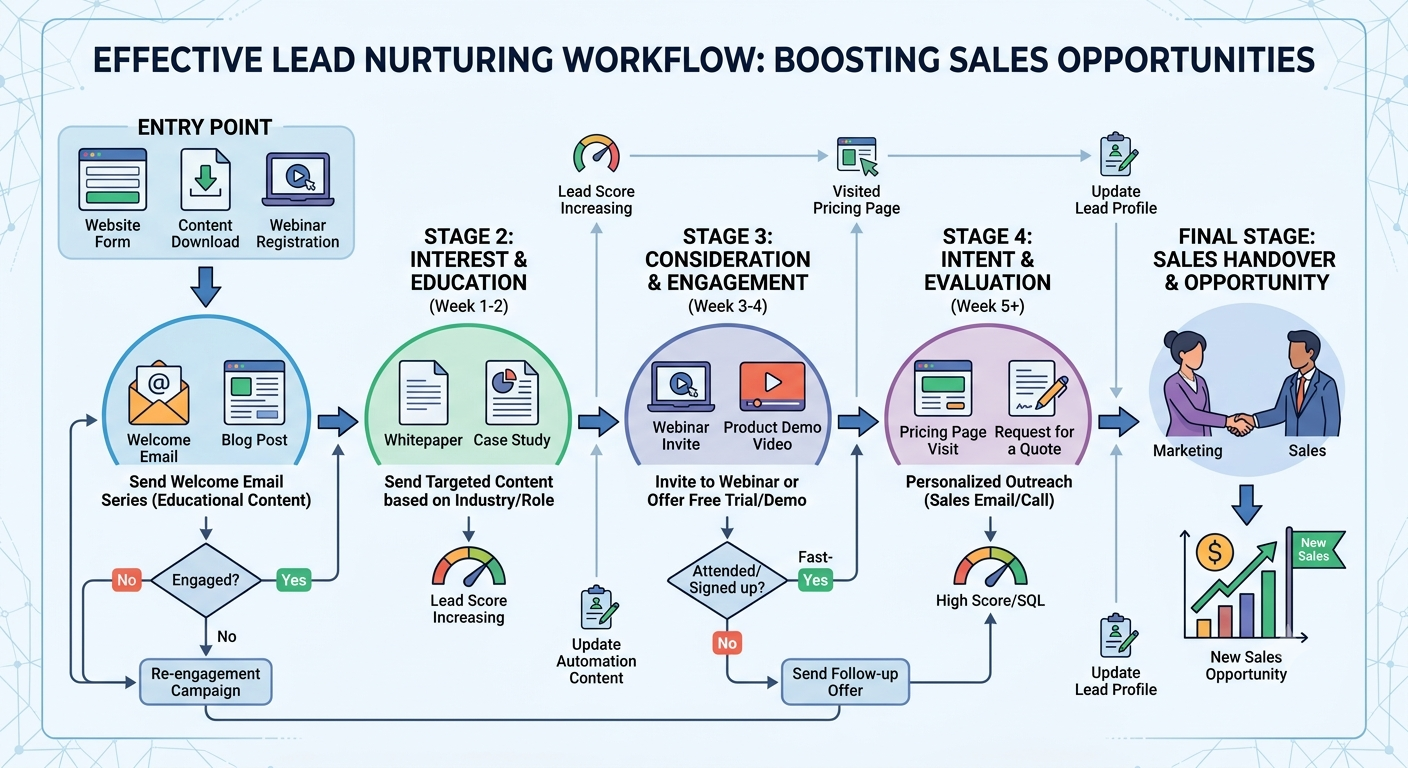
Most lead scoring models reward clicks and form fills. That’s useful but insufficient. A revenue-focused nurture workflow layers in intent data—topics being researched, competitor page visits, review site activity—and adjusts priority in real time. A contact who suddenly spikes on “pricing” intent signals gets routed into a high-touch sequence that combines marketing content with an SDR call, not another generic nurture email. This shortening of the path from interest to opportunity directly improves the velocity of pipeline revenue.
2. Account-Level Enrollment, Not Just Contact-Level
If three people at the same company are quietly engaging with your technical documentation and case studies, your nurture workflow must recognize that as an account surge. The best demand gen teams have a workflow that auto-enrolls all known contacts from that account into a curated “active evaluation” track, and simultaneously pushes a signal to the account owner. This transforms nurture from a single-threaded conversation into a coordinated account penetration motion, which research from TOPO (now Gartner) shows can increase average deal size by up to 25%.
3. Dynamic Content Paths Tied to Buying Stage, Not Just Persona
Too many nurture workflows are persona-based: “This is the CFO track, send financial content.” But a CFO in early education mode needs very different messaging than a CFO actively building a business case. Revenue-centric workflows use conditional branches based on recent content consumption, website behavior, and stage of the opportunity. A practical example: a lead who repeatedly visits customer story pages and the pricing page gets a case study with ROI data, followed by an invitation to an executive briefing. Every piece of content is selected to nudge the buying stage forward, not just to “stay top of mind.”
4. Sales Hand-Off Triggers That Are Binary and Bi-Directional
Vague SLA definitions kill nurture effectiveness. The organizations that excel at creating sales opportunities have a simple, binary trigger: when a contact (or account) hits a defined score threshold and displays a specific intent signal, a task is created in the CRM for an SDR. But the workflow doesn’t stop there—it provides the SDR with a pre-built email template, a summary of the nurture interaction history, and a time-bound action window. If the SDR doesn’t act, marketing gets the contact back into a structured follow-up cadence. This closed-loop system ensures no hand-off is dropped, and marketing attribution for sourced pipeline remains clean.
5. Closed-Loop Measurement Back to Revenue
Every nurture sequence in a sophisticated workflow is tagged so that marketing operations can trace an opportunity’s origin back to a specific nurture track. The key metrics are not open rate or click-through rate; they are nurture-to-opportunity conversion rate, nurture-influenced pipeline, and ultimately nurture-influenced closed-won revenue. This lets the CMO show a direct line from the nurture engine to the company’s LTV:CAC ratio and overall capital efficiency. That’s the data that secures budget, not a vanity metric dashboard.
The 5-Step Revenue Nurture Architecture
Rebuilding your lead nurturing workflows doesn’t require ripping out your marketing automation platform. It requires redesigning the logic using this step-by-step framework.
- Define what “sales opportunity” means for nurture. Sit with sales leadership and agree on the exact signal that qualifies a nurtured lead for hand-off. Example: “Account-level engagement from 2+ contacts, plus a high-intent page visit in the past 7 days.” Document this as a shared truth.
- Audit existing nurture tracks and discard what doesn’t convert. Run a funnel analysis from nurture entry to opportunity creation over the last four quarters. Ruthlessly kill tracks with less than a 2% opportunity conversion rate, or redesign them completely.
- Layer intent data into your enrollment criteria. Pick one third-party intent source (or use first-party website surges) and create a “hot account” nurture workflow that overrides standard drip programs. This workflow should be aggressive, multi-channel, and include direct sales outreach.
- Build an account-based nurture stream. For your top-tier target accounts, create a dedicated nurture sequence that personalizes content to specific buying roles and is activated by account-level behavior. Integrate it with your ABM platform so that ads, emails, and SDR calls work together.
- Set up real-time reporting on pipeline influence. Work with RevOps to build a dashboard that tracks, per nurture track: number of contacts enrolled, number of sales conversations created, opportunities generated, and closed-won revenue. Review quarterly and adjust the logic based on what actually drives revenue, not what drives clicks.
To make this tangible, here’s a comparison of the old-school approach versus the revenue-first lead nurturing workflow design:
| Aspect | Traditional Nurture | Revenue-First Nurture Workflow |
|---|---|---|
| Trigger | Form fill, list upload | Intent signal, account surge, buying stage change |
| Scope | Individual contact | Account with all known contacts |
| Content path | Persona-based, static sequence | Dynamic, based on real-time behavior and stage |
| Sales hand-off | Score threshold, often ignored | Binary trigger with SDR task, template, and time window |
| Success metric | Open rate, click-through rate | Pipeline revenue, opportunity conversion, LTV impact |
| Attribution approach | Last-touch, campaign-level | Multi-touch with nurture track influence on pipeline and closed revenue |
Common Mistakes That Turn Nurture Workflows into Revenue Leaks
Designing Around Content You Have, Not Content Buyers Need
Marketing teams often build nurture tracks by repurposing existing assets, resulting in sequences that don’t match the buyer’s evolving questions. The fix: map your nurture content to specific deal-stage transitions—problem identification, solution exploration, vendor evaluation, business case building—and create the missing assets. A nurture workflow without stage-appropriate content will stall deals, not progress them.
Setting It and Forgetting It
Many nurture workflows are launched with fanfare and never revisited. Conversion rates decay over time as offers go stale and buyer behaviors shift. Run a quarterly “nurture scrubbing” session where you review performance data and refresh at least the top-of-funnel tracks. Treat nurture like a product that needs constant iteration, not a set-and-forget campaign.
Ignoring the ‘Dark Funnel’
A big chunk of B2B research happens in places marketing can’t see—peer communities, review sites, private groups. A lead who appears unengaged in your nurture emails may be actively evaluating you on G2 or Reddit. The mistake is assuming silence means disinterest. Build workflows that can incorporate dark funnel signals (e.g., spikes in G2 profile views) via APIs or manual intelligence from SDRs, and reactivate those leads accordingly.
Measuring Nurture in Isolation
If your nurture reports only show email metrics, you’ll optimize for opens, not opportunities. This creates a self-licking ice cream cone: the emails get more “engaging,” but sales conversations don’t increase. Every nurture report must tie back to downstream CRM data—opportunities created, pipeline generated, deal velocity, and ultimately the impact on CAC and LTV. If that connection isn’t instrumented, you’re flying blind.
The Next Generation of Revenue Nurturing
Looking ahead, three developments are set to reshape lead nurturing workflows. First, the integration of real-time conversational signals—from chatbots, meeting transcripts, and social touches—will enable nurture programs that adapt not just to content consumption but to actual questions and objections. Second, the maturation of marketing attribution platforms and data warehouses means that nurture’s impact on multi-touch pipeline influence will become standard boardroom reporting, making the CMO’s contribution to pipeline revenue undeniable. Third, as buying committees grow even larger, account-based nurture will evolve into buying-group orchestration, where workflows coordinate distinct messages and channels for each member of the committee in parallel, accelerating consensus.
The teams that invest in the skills and technology to build these signal-responsive, revenue-attached nurture architectures now will be the ones that transform marketing’s role from a lead factory to a true pipeline partner. The rest will keep sending drips no one reads, wondering why the sales team never looks at their MQL report.
FAQ Section
1. What exactly is a lead nurturing workflow? A lead nurturing workflow is a structured, automated set of marketing actions—typically across email, social, and sales outreach—designed to move a contact or account from initial interest to a sales-ready opportunity based on behaviors, intent signals, and predefined rules. It coordinates timing, content, and channel to build trust and accelerate purchase readiness.
2. How do lead nurturing workflows increase sales opportunities? They systematically identify, educate, and advance prospects who aren’t yet ready to buy. By responding to buying signals with relevant content and timely sales hand-offs, these workflows convert passive researchers into active evaluators, directly creating more qualified pipeline and shortening the sales cycle, which lowers customer acquisition cost (CAC).
3. What metrics should I track to measure nurture success? Track nurture-to-opportunity conversion rate, nurture-influenced pipeline revenue, sales conversations generated, and closed-won revenue from nurtured leads. Also monitor velocity improvements and the impact on LTV:CAC ratio. Avoid measuring success solely by email open rates or click-throughs, as those don’t correlate with revenue outcomes. 4. How does account-based nurturing differ from traditional lead nurturing? Traditional nurturing focuses on an individual lead. Account-based nurturing targets entire buying groups at a target account, orchestrating multi-contact, multi-channel touches based on account-level signals. This aligns marketing with how B2B purchases are actually made—by committees—and typically results in larger deal sizes and faster consensus.
5. When should a nurtured lead be handed off to sales? When a binary, jointly defined trigger is met—for example, a contact hits a lead score threshold AND displays a high-intent action like pricing page visits. The hand-off should include context (nurture history, content consumed) and a time-bound sales task to ensure prompt follow-up. Vague or score-only hand-offs result in ignored leads.
6. How can intent data improve lead nurturing workflows? Intent data reveals when accounts are actively researching topics related to your solution, even before they visit your site. By ingesting this data, you can trigger a high-priority nurture track, personalize messaging to the research topic, and alert sales, dramatically increasing the chances of creating a timely sales conversation.
7. What’s the most common reason nurture programs fail to generate pipeline? They aren’t connected to revenue outcomes. Teams optimize for email engagement instead of opportunity creation, resulting in “zombie” nurtures that keep contacts warm but never push them into a buying process. The fix is to redesign workflows around stage transitions and sales triggers, with CRM-attached measurement. 8. How often should I review and update my lead nurturing workflows? At minimum, quarterly. Review opportunity conversion rates by nurture track, refresh content, update triggers based on shifting buyer behavior, and incorporate new intent signals. Treat nurture logic as a living system, not a one-time campaign setup, to maintain its effectiveness in generating pipeline.
9. Can marketing attribution accurately track nurture’s impact on revenue? Yes, if you design for it. Use UTM parameters and campaign codes tied to specific nurture tracks, and configure your CRM and marketing analytics to report on multi-touch influence. While perfect precision is elusive, a consistent attribution model that shows nurture’s role in the customer journey provides credible evidence for budget and strategy decisions.
10. What tools are essential for building advanced lead nurturing workflows? A marketing automation platform (HubSpot, Marketo, Pardot), a CRM with tight integration, an intent data provider (6sense, Bombora), and an account-based orchestration tool if you’re targeting enterprise accounts. Also, a data warehouse or analytics tool (like Tableau or Looker) to connect nurture engagement to pipeline and revenue data for accurate reporting.
Nurture Is a Revenue Function, Not a Marketing Function
The organizations that consistently turn their marketing database into sales opportunities have stopped treating nurturing as a cost of doing business and started treating it as a strategic revenue lever. They build lead nurturing workflows that react to reality—intent surges, account movements, buying stage shifts—and hand off opportunities with precision. They measure success not by the send button, but by the pipeline generated and the deals closed.
This shift demands a willingness to kill legacy drip campaigns, to instrument the technology stack for closed-loop attribution, and to share definitions of “opportunity” with sales. But the payoff is immense: higher conversion rates, more efficient CAC, and a stronger connection to the LTV that drives enterprise value. If your current nurture engine feels like a hamster wheel of content, it’s time to rebuild the architecture. The framework is here; the next step is execution.