AI-Powered Lead Scoring Cuts Sales Cycles by 40% in 2026
Here’s a number that should make any sales leader sit up: teams running AI-driven lead scoring are reporting sales cycles up to 40% shorter than they were two years ago. Not because reps are working harder, but because they’re finally talking to the right people at the right time.
A quick caveat before we go further. The 40% figure is a best-case result drawn from vendor case studies and early adopter reports, not a universal benchmark. Your results will depend on your data, your deal size, and how well sales and marketing agree on what a “good” lead looks like. But even if you land at half that improvement, it’s worth a hard look. Here’s what’s behind the numbers and what to do about them.
Why Traditional Lead Scoring Stalled
Most B2B teams still run some version of the points system. A whitepaper download gets 10 points. A pricing page visit gets 20. A VP title adds 15. Cross a threshold, and the lead goes to sales.
It worked fine when buying was simpler. It doesn’t hold up now. Buying committees have grown, journeys span months and channels, and a single contact’s activity tells you very little about whether an account is ready to buy. Static rules also decay. The weights somebody picked in 2022 are still sitting in your system, quietly misdirecting your reps.
Enjoying this article? Get B2B marketing intelligence every weekday morning.
Subscribe Free — Takes 10 Seconds →The result is a familiar frustration. Sales says the leads are junk. Marketing says sales doesn’t follow up. Both are partly right, and the deals drag on while everyone argues.
What AI Scoring Actually Does Differently
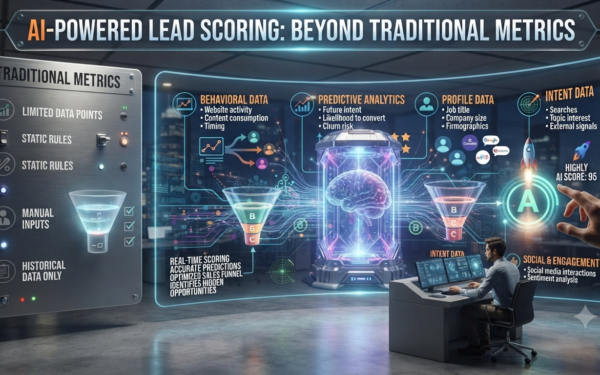
AI-powered scoring replaces hand-picked weights with models trained on your own closed-won and closed-lost history. Instead of guessing which behaviors matter, the model finds the patterns that really preceded a purchase, and it keeps updating as new outcomes come in.
It reads more signals
Modern models pull from firmographics, website and email engagement, product usage, CRM history, ad interactions, and third-party intent data. Salesforce Einstein, HubSpot’s predictive scoring, and tools built on Google Cloud’s machine learning services all work this way, and LinkedIn’s account-level engagement data is increasingly part of the mix for teams running paid social.
It scores accounts, not just people
This is where the biggest gains tend to show up. When five people from one company each take a small action, no single contact looks hot. At the account level, that’s a clear buying signal. Teams that pair scoring with an account-based marketing approach get far more value from it than those scoring individuals in isolation.
It updates continuously
A model retrained monthly or weekly adapts to shifts in your market. A points system only changes when someone remembers to change it.
The speed gain doesn’t come from the algorithm being clever. It comes from sales skipping the leads that were never going to close and getting to the ones that will, sooner.
If you want a deeper look at the mechanics, our guide to predictive lead scoring walks through how these models are built and tested.
Where the 40% Comes From
Shorter cycles come from a few specific places, and it helps to know which apply to you.
- Faster first response. High-scoring leads get routed to reps within minutes, not days. Speed to contact still correlates strongly with conversion.
- Less wasted effort. Reps stop working low-probability leads, which frees time for deals that can actually move.
- Better timing. Scoring flags when an account’s engagement spikes, so outreach lands when interest is real.
- Earlier stakeholder mapping. Account-level signals show you which other people at the company are getting involved, so reps can multi-thread sooner.
Notice that none of these is purely a technology benefit. Each depends on a process change: routing rules, follow-up expectations, and rep behavior. The model produces a score. People produce the shorter cycle.
What This Means for B2B Marketers
Your job shifts from volume to quality
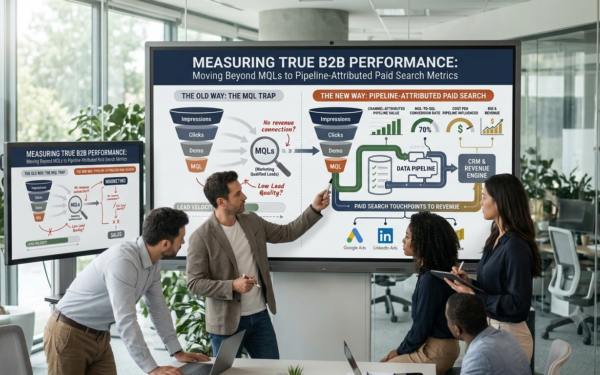
If you’ve been judged on MQL counts, AI scoring will make that metric look worse before it looks better. Fewer leads will qualify. That’s the point. The right measure becomes pipeline velocity, win rate, and revenue per lead. If your leadership still wants raw lead volume, now’s the time to reset expectations, and our piece on B2B marketing metrics offers a framework for that conversation.
Alignment isn’t optional anymore
A scoring model is only as good as the outcome data it learns from. If reps don’t update opportunity stages honestly, or marketing and sales define “qualified” differently, the model learns the wrong lessons. Strong sales and marketing alignment is the foundation here, not a nice extra.
Data hygiene becomes a revenue issue
Duplicate records, missing fields, and inconsistent stage definitions all weaken a model. Many teams find the first month of an AI scoring project is really a data cleanup project. That’s not a failure. It’s the work that makes everything after it possible. If you’re also weighing where your customer data should live, our comparison of CDP vs CRM can help you decide.
Analysis: Who Gets the Gains, and Who Doesn’t
Not every team will see dramatic results. Here’s a realistic read on where this works best.
Strong fit: Companies with at least a few hundred closed deals in their history, a reasonably long sales cycle, and enough lead volume that prioritization actually matters. Mid-market and enterprise B2B software, professional services, and manufacturing often fit this description.
Weaker fit: Very small teams with limited deal history, or businesses with a handful of large deals a year. There isn’t enough data for a model to learn from, and a simple, well-maintained rules system may serve you better.
There’s also the question of trust. Reps who don’t understand why a lead scored high will ignore the score. The better platforms now show the top factors behind each score, and that transparency matters. If your tool can’t explain itself, adoption will suffer.
Finally, be skeptical of any vendor promising a specific percentage before they’ve seen your data. Ask for results from companies similar to yours in size, sector, and deal complexity. And insist on a holdout test: score a portion of leads with the model, leave a comparable group on your old process, and measure the difference over a full cycle.
A Practical Rollout Path
- Audit your data first. Check stage definitions, duplicate rates, and how consistently closed-lost reasons are recorded.
- Agree on the target outcome. Decide whether you’re predicting opportunity creation, closed-won, or something else. Be specific.
- Start with the tools you have. Salesforce and HubSpot both offer built-in predictive scoring. Test those before buying a separate platform.
- Set routing and follow-up rules. Define what happens when a lead crosses the threshold and how fast.
- Run a controlled test. Compare against your current process for at least one full sales cycle.
- Review and retrain. Check model performance regularly and fix drift early.
What to Watch
A few developments will shape how this plays out over the next year.
Scoring built into everything
Predictive scoring is becoming a standard feature rather than a premium add-on. As it spreads across the stack, the advantage will shift from having a score to using it well. For the bigger picture, see our look at MarTech trends in 2026 and the latest marketing automation trends.
Attribution questions
When scoring changes which leads reach sales, it also changes what your attribution reports say about channel performance. Expect some uncomfortable conversations about which programs really drive revenue. Our guide to B2B attribution is a useful companion here.
Privacy and data access
Tighter rules on tracking and third-party data will limit some signals. Teams with strong first-party data will have an edge, since they won’t depend on sources that may shrink.
Model transparency
Look for more pressure on vendors to explain their scores. Buyers and regulators both want to know how automated decisions get made, and reps want to know why they’re being told to call someone.
The Bottom Line
A 40% shorter sales cycle is a real possibility, but it isn’t automatic. It comes from clean data, a shared definition of a good lead, and reps who act on the signal quickly. Get those three right, and the technology does what it promises. Skip them, and you’ve bought an expensive way to produce a number nobody trusts.
Start small, test honestly, and measure velocity rather than volume. That’s the version of this that holds up when the budget review comes around.
Want B2B marketing insights every week? Subscribe to Marktngwave.