For most of the last decade, the default way to give marketing a unified customer view was to buy one: a packaged customer data platform or a marketing cloud that collected data, stitched identities, built audiences and pushed them to channels, all inside the vendor’s walls. In 2026 a growing number of B2B teams are taking a different route. They are building a composable martech stack, where the company’s own cloud data warehouse sits at the center, and modular tools for modeling, identity, reverse ETL and activation plug into it.
Composable is not automatically better. It moves work, cost and responsibility around rather than making them disappear. This guide explains what a composable stack really is, when it beats a packaged suite, how to handle governance and consent, what drives cost, and a phased migration plan you can adapt.
Why composable is on the 2026 agenda
First, too much software, used too little. The 2025 Marketing Technology Landscape from chiefmartec and MartechTribe counted 15,384 martech solutions, up 9% in a year. Meanwhile, Gartner’s 2025 Marketing Technology Survey data snapshots put average utilization of martech stack capabilities at 49%, up from 33% in 2023. Gartner estimates that average utilization can mean up to $8.57 million in wasted martech spend for a $1 billion revenue company. When half of what you pay for sits idle, buying another all-in-one platform is a hard sell.
Second, the center of gravity is shifting toward the warehouse. In the same chiefmartec research, among B2C and hybrid companies the share naming a CDP as the center of their stack fell from 26.9% to 17.4%, while the share naming a cloud data warehouse rose from 20.9% to 23.9%. Scott Brinker summed up the trend this way: “CDP capabilities seem to be moving to either the warehouse layer (‘composable CDPs’) or the engagement layer, where they are increasingly embedded into customer-facing platforms.” B2B respondents still mostly put their CRM or marketing automation platform at the center, but the share answering “Other”, which includes custom-built platforms, rose from 2% to 10%.
Enjoying this article? Get B2B marketing intelligence every weekday morning.
Subscribe Free — Takes 10 Seconds →Third, the data tooling market is consolidating around the warehouse. In May 2025, Fivetran agreed to acquire reverse ETL pioneer Census; TechCrunch reported that customers had been asking Fivetran for a reverse ETL product for years. In June 2026, Fivetran also completed its merger with dbt Labs, combining ingestion, transformation and activation under one roof. The signal for marketers: moving data into the warehouse, modeling it and pushing it back out to business tools is now mainstream infrastructure.
What a composable martech stack actually is
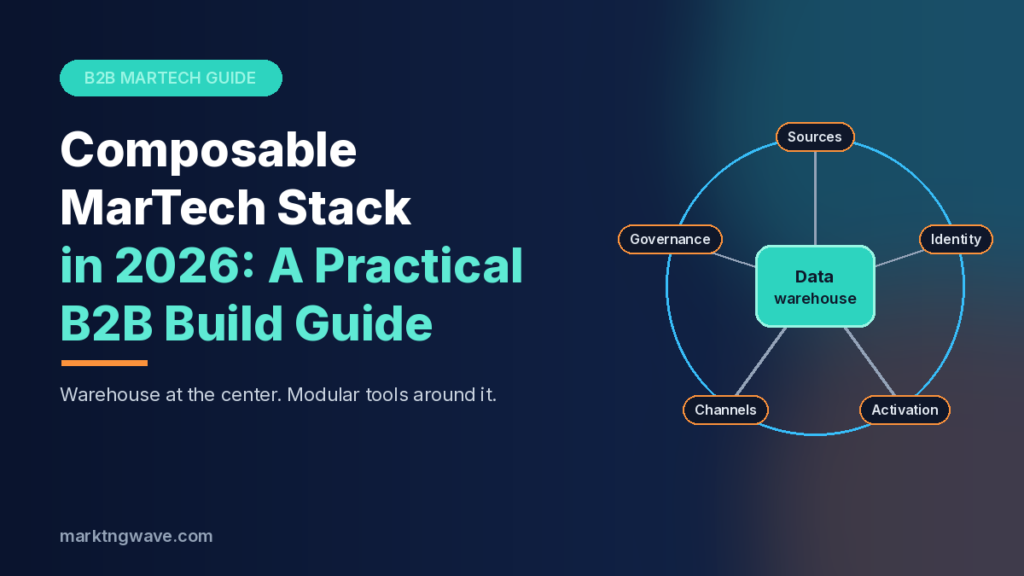
A composable stack treats the data warehouse (or lakehouse) as the single source of truth for customer and account data, then assembles best-fit components around it. A typical B2B version has five layers:
- Sources. CRM, marketing automation, product usage events, website analytics, billing, support, ads platforms and intent or enrichment data.
- Ingestion and storage. Managed connectors and event pipelines land raw data in the warehouse, which becomes the hub.
- Modeling and identity. SQL-based transformation builds clean tables for people, accounts, opportunities and buying groups. Identity resolution links contacts to accounts and devices to people. This is where your definitions of a qualified account, an active user or a churn risk live.
- Activation. Reverse ETL or a warehouse-native CDP audience tool syncs modeled fields and segments back into the CRM, marketing automation, ad platforms, sales engagement and customer success tools.
- Channels. Email, paid media, website personalization, sales outreach and in-product messaging use the synced data to act.
Wrapped around all of it is a governance layer: consent and preference data, access controls, data quality tests, lineage and an audit trail of what was sent where.
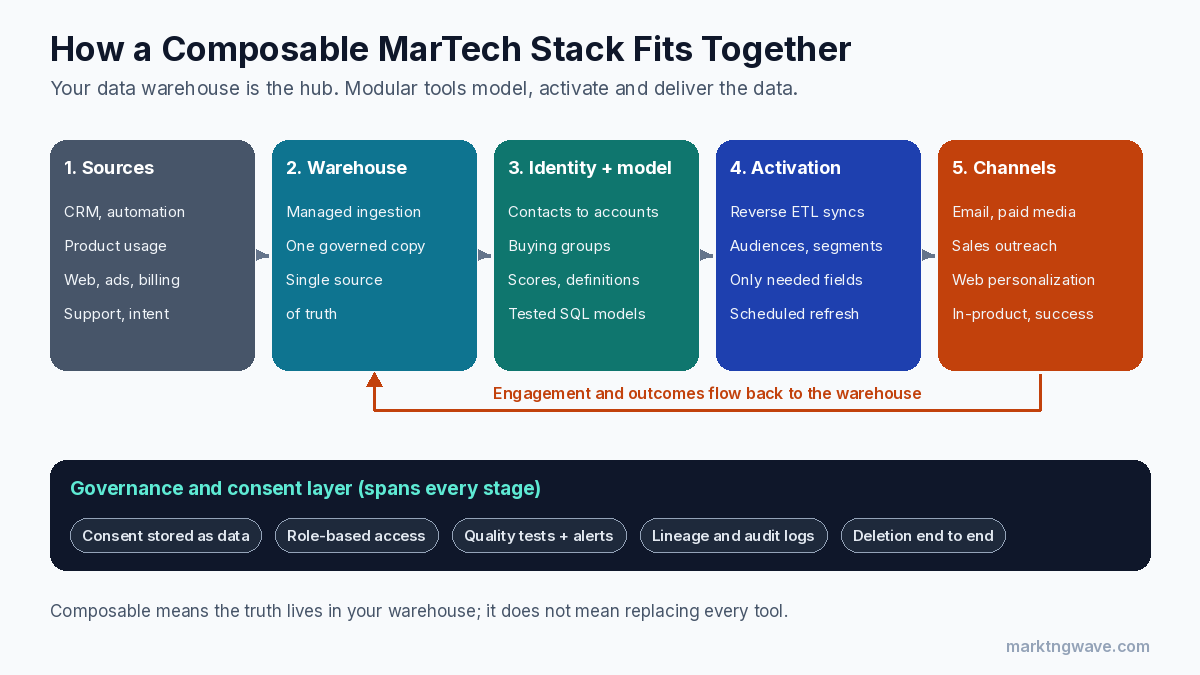
A “composable CDP” or “warehouse-native CDP” is simply the CDP functions, such as identity, audience building and activation, delivered on top of your warehouse instead of in a separate copy of the data. If you are still deciding which system should own customer data in the first place, start with our guide to CDP vs CRM in 2026.
Composable vs packaged: an honest comparison
| Dimension | Composable (warehouse-native) | Packaged CDP or marketing suite |
|---|---|---|
| Where customer data lives | In your own warehouse; tools read from it | In the vendor’s platform, as a separate copy |
| Time to first value | Fast if a warehouse and data team already exist; slow if not | Usually faster for teams starting from scratch |
| Flexibility | Swap or add components; model any entity, including accounts and buying groups | Limited to the vendor’s data model and roadmap |
| Skills required | SQL, data modeling and pipeline ownership | Mostly marketer-operated configuration |
| Cost profile | Several smaller licenses plus warehouse compute and people time | One larger license, often priced by profiles or events |
| Governance | Centralized in one place, but you must design it | Built-in controls, but data is copied into another system |
| Main risk | Integration sprawl and unclear ownership between marketing and data teams | Lock-in, duplicate data and paying for unused features |
When to go composable, and when not to
Composable is usually the right call when
- You already run a cloud data warehouse that finance, product or analytics teams trust.
- You have, or can borrow, analytics engineering capacity to own models and pipelines.
- Your B2B motion needs custom entities: accounts, buying groups, product-qualified accounts, partner relationships or usage tiers.
- Product usage data matters for scoring, expansion or churn, and it already lands in the warehouse.
- You want to avoid copying sensitive data into yet another vendor.
A packaged suite may be better when
- There is no warehouse, or no one owns data engineering.
- Your use cases are mainstream (email nurture, basic segmentation, ad audiences) and the suite covers them well.
- Speed matters more than flexibility, and the team is small.
- Real-time, in-session personalization is the core requirement and your warehouse setup cannot support it yet.
Many teams land on a hybrid: the warehouse owns the golden record and the models, while the marketing automation platform or CRM remains the place where marketers build journeys. Composable describes where the truth lives, not a mandate to replace every tool.
Governance and consent: design it in, not on
The appeal of composable architecture is one governed copy of customer data. The danger is that reverse ETL makes it very easy to push that data into dozens of tools. Regulators are paying attention: according to DLA Piper’s January 2026 GDPR fines and data breach survey, European authorities issued around EUR1.2 billion in GDPR fines in 2025, and daily breach notifications rose 22% to an average of 443. The firm also noted that processors, not only controllers, were fined directly for security failures. Every activation destination you add extends that chain.
Practical guardrails for a composable stack:
- Store consent as data. Keep consent, legal basis, region and channel preferences in a modeled table, and make every audience query join to it.
- Sync the minimum. Send only the fields a destination needs. A scoring field rarely needs to travel with a full contact history.
- Control access by role. Separate who can build models, who can create audiences and who can turn on a new destination.
- Test and monitor. Add data quality tests on key models and alerts on sync failures, so a broken model does not quietly email the wrong segment.
- Keep lineage and logs. You should be able to answer “which tools received this person’s data, and when?” in minutes.
- Handle deletion end to end. A deletion request must propagate from the warehouse to every synced destination.
Ownership matters as much as tooling. Gartner’s survey found that 50% of martech funding comes from outside marketing, including 34% from IT. A composable stack makes that partnership explicit, so write down who owns models, destinations and consent logic before you build.
What a composable stack really costs
Composable is often pitched as cheaper. Sometimes it is, but model the full picture, not just license prices:
- Licenses: ingestion, transformation, activation or warehouse-native CDP, and identity or enrichment tools.
- Warehouse compute and storage: frequent audience refreshes and heavy identity jobs can grow the bill. Set refresh schedules by use case, not “as often as possible”.
- People: analytics engineering and marketing operations time to build and maintain models and syncs. This is the line most business cases leave out.
- Savings: retired tools, fewer duplicate data copies, and less manual list-pulling.
Given Gartner’s utilization numbers, a good first step is an audit of what you already own. Retiring overlapping tools can fund much of the move.
A phased migration plan
Phase 1: Audit and pick use cases (weeks 1 to 4)
Inventory tools, data flows, contract renewal dates and owners. Choose two or three high-value use cases, such as syncing a product-usage score to the CRM, building account-level ad audiences or flagging expansion signals for customer success.
Phase 2: Build the foundation (weeks 4 to 10)
Land core sources in the warehouse. Build modeled tables for contacts, accounts and opportunities, plus a consent table. Agree definitions with sales and finance, and add tests.
Phase 3: Activate and prove (weeks 10 to 16)
Turn on reverse ETL for the chosen use cases. Run them alongside the old process and compare data quality, speed and outcomes. Measure lift with holdouts where you can; our guide to B2B attribution, MMM and incrementality covers how.
Phase 4: Expand and retire (month 4 onward)
Add use cases one at a time. Retire overlapping tools at their renewal dates, not mid-contract. Review costs and governance quarterly.
Composable martech stack checklist
- A trusted warehouse exists, with a named owner.
- Contacts, accounts and opportunities are modeled with agreed definitions.
- Consent and preferences are stored as data and enforced in every audience.
- Each destination receives only the fields it needs.
- Data quality tests and sync alerts are live.
- Roles for modeling, audience building and new destinations are separated.
- The business case includes compute and people costs, not only licenses.
- Overlapping tools have retirement dates tied to renewals.
Key takeaways
- A composable martech stack puts your warehouse at the center and plugs modular tools into it.
- It fits B2B teams with a trusted warehouse, data skills and custom account-level needs.
- Packaged suites still win on speed for small teams without data engineering.
- Governance and consent must be built into the models, because activation makes data easy to spread.
- Migrate by use case, prove value in parallel, and retire tools at renewal.
FAQ
What is a composable martech stack?
It is a marketing technology architecture in which a company’s cloud data warehouse acts as the central source of customer and account data, and separate, interchangeable tools handle ingestion, modeling, identity, activation and channels.
Is a composable CDP the same as reverse ETL?
Not exactly. Reverse ETL is the capability of syncing data from the warehouse into business tools. A composable or warehouse-native CDP usually includes reverse ETL plus audience building, identity resolution and marketer-friendly interfaces on top of the warehouse.
Do I need to replace my marketing automation platform?
No. In most B2B composable stacks, the marketing automation platform and CRM stay. They simply receive cleaner, richer data from the warehouse instead of acting as the only source of truth.
Is composable cheaper than a packaged CDP?
Not always. It can reduce licensing and duplicate data, but it adds warehouse compute and people time. Build a total-cost comparison before deciding.
Stay ahead of B2B MarTech
Want practical guides on data architecture, measurement and AI-powered marketing every week? Subscribe to Marktngwave and get new analysis delivered straight to your inbox.